Can a 1000W Power Station Run a Sump Pump? (Startup Surge Math)
Quick Specification & Sizing Overview
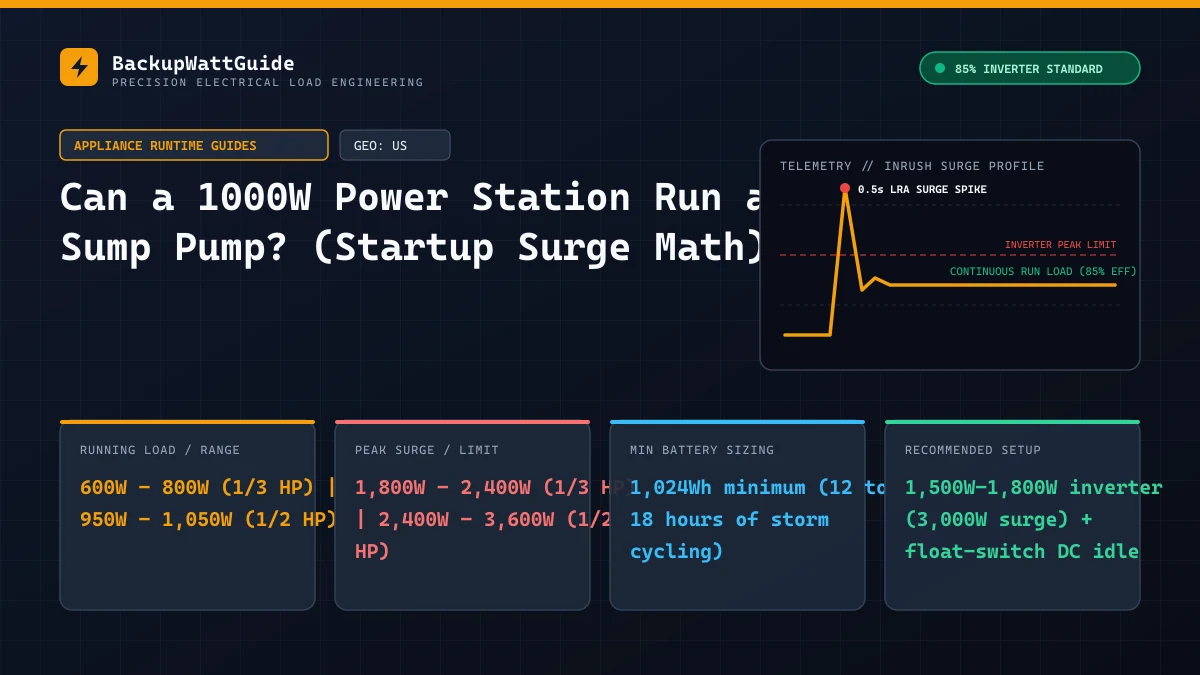
A standard 1/3 horsepower (HP) basement sump pump draws between 600 and 800 running watts, which looks on paper like an easy job for a 1000W portable power station. The catch happens during the first 0.5 seconds of every pump cycle: a split-phase induction motor sitting at the bottom of a water-filled pit pulls 1,800 to 2,400 starting surge watts to get the impeller spinning against gravity and check-valve pressure.
Because most 1000W portable power stations carry a hard surge ceiling of 2,000W, a 1000W station will run a low-draw 1/4 HP or efficient 1/3 HP pump (like a Zoeller M53) if nothing else is plugged into it, but it will immediately trip into an overload fault on a high-inrush 1/3 HP or any 1/2 HP sump pump. Before you rely on a 1000W battery box during a midnight thunderstorm, you need to check the Locked Rotor Amps (LRA) stamped on your pump’s nameplate and account for a hidden battery killer that catches almost every homeowner off guard: 24-hour AC inverter idle drain.
Sump pump running watts vs. startup surge watts by horsepower
Submersible and pedestal sump pumps use AC induction motors. When the float switch rises and closes the circuit, the rotor is stationary (locked) and acts like a momentary short circuit until back-electromotive force (back-EMF) builds up in the windings. During those first 300 to 600 milliseconds, the motor demands 2.5 to 3.5 times its continuous running current.
Compare the electrical demand of standard 120V North American sump pumps against the inverter limits of a typical 1000W power station below:
| Sump Pump Size | Typical Running Amps (120V) | Continuous Running Watts | Startup Surge Watts (0.5 Sec) | Will a 1000W Power Station (2000W Peak) Run It? |
|---|---|---|---|---|
| 1/4 HP Submersible | 4.0A – 5.0A | 480W – 600W | 1,200W – 1,500W | Yes. Runs reliably with 500W of surge margin to spare. |
| 1/3 HP Cast Iron (Low-Amp, e.g., Zoeller M53) | 4.8A – 5.5A | 575W – 660W | 1,500W – 1,850W | Yes, provided no other appliances are plugged into the station. |
| 1/3 HP High-Head / Standard PSC Motor | 6.5A – 8.0A | 780W – 960W | 2,100W – 2,600W | Borderline / Fails. Frequently trips E01 overload on 2000W-peak inverters. |
| 1/2 HP Submersible | 8.5A – 10.5A | 1,020W – 1,260W | 2,400W – 3,600W | No. Exceeds both the 1000W continuous and 2000W surge limits. |
| 3/4 HP Heavy Duty | 11.0A – 13.5A | 1,320W – 1,620W | 3,300W – 4,200W | No. Requires a 2,000W to 2,400W continuous inverter (4,000W+ surge). |
If you already tried plugging your pump in and the battery station beeped and shut off its AC ports, read our diagnostic steps on how to fix error code E01, E02, and E03 on portable power stations to clear the inverter latch safely.
How to calculate your exact pump surge from the nameplate tag
You do not need to lift the heavy cast-iron pump out of the sump basin to check its wattage. Most manufacturers attach a duplicate metal or Mylar specification tag near the top of the 120V power cord, or list the exact motor ratings in the owner’s manual. Look for two numbers: FLA (Full Load Amps) and LRA (Locked Rotor Amps).
Use these two formulas to convert those amp ratings into watts for a standard 120V US or Canadian circuit:
Real-world example: Zoeller M53 (1/3 HP) vs. Wayne CDU800 (1/2 HP)
- Zoeller Model 53 (1/3 HP): According to the official Zoeller M53 technical data sheet, the 115V/120V model draws 4.8 Full Load Amps and 13.8 Locked Rotor Amps at initial start.
- Running load:
- Startup surge:
- Verdict: Because 1,656W sits comfortably under the 2,000W surge ceiling of a 1000W power station, a 1000W unit runs a Zoeller M53 without tripping.
- Standard 1/2 HP Submersible Pump: A typical 1/2 HP capacitor-start pump lists 9.5 FLA and 23.0 LRA.
- Running load:
- Startup surge:
- Verdict: A 1000W power station fails instantly. Even a newer 1,500W to 1,800W unit (such as the Anker SOLIX C1000 at 1,800W continuous / 2,400W peak, or Bluetti AC180 at 1,800W continuous / 2,700W lifting) sits right on the edge of a 2,760W inductive spike. For a 1/2 HP pump, step up to a 2,000W+ inverter or choose a station rated for 3,000W to 3,600W pure sine wave surge.
Why “X-Boost” and “Power Lifting” modes do not work on sump pumps
When shopping for a 1000W class power station, you will see marketing claims stating the inverter can “run appliances up to 2,400W or 2,700W” using software modes called EcoFlow X-Boost, Bluetti Power Lifting, or Anker SurgePad.
Do not count on those modes to start a sump pump. Those features are not true surge capacity; they are voltage-throttling algorithms. When an appliance demands more wattage than the inverter’s native rating, X-Boost and Power Lifting intentionally drop the output voltage from 120V down to 85V–100V to force the amperage and total watts back under the inverter’s hardware ceiling.
- Where voltage throttling works: Resistive heating loads like coffee makers, hair dryers, and electric kettles. Drop the voltage to a toaster, and the coils simply glow slightly cooler and take 30 seconds longer to toast bread.
- Why it destroys sump pump performance: An induction motor driving an impeller against 8 to 10 feet of vertical PVC pipe head pressure requires full 120V line voltage to generate starting torque. If the inverter drops voltage to 92V during startup, the motor stalls in a “locked rotor” hum, pulls maximum current continuously, and trips either the power station’s
E01overload or the pump’s internal thermal overload within three seconds.
Always disable X-Boost / Power Lifting in the mobile app when using a portable power station for basement flood protection. You want a true 120V pure sine wave surge rating that exceeds your pump’s LRA wattage.
The hidden math: continuous runtime vs. real-world storm cycle runtime
If you plug an 800W sump pump into a 1,024Wh power station and calculate continuous runtime, the battery only lasts about 1.06 hours (64 minutes) before hitting 0%.
Fortunately, a basement sump pump almost never runs continuously. Even during a heavy spring downpour or rapid snowmelt, a standard 1/3 HP pump moves 40 to 60 gallons per minute (GPM)—emptying an 18-inch sump pit in 12 to 20 seconds before shutting off and waiting for groundwater to seep back in.
However, waiting between cycles creates a second math problem: Inverter Parasitic Idle Draw. Because the pump turns on automatically via its pit float switch, you must leave the power station’s 120V AC inverter button switched ON all night. Just keeping the AC inverter energized burns 15W to 22W per hour with zero watts going to the pump.
Here is how to calculate your true storm endurance across a 24-hour blackout:
Sump pump storm runtime chart for a 1,024Wh battery (700W 1/3 HP pump)
Assuming an 85% AC inverter efficiency (870Wh usable energy) and an 18W continuous inverter idle draw, look at how long a 1,024Wh power station actually keeps your basement dry across four different rain intensities:
| Storm Intensity | Pump Cycle Frequency (15-Sec Pump Duration) | Hourly Duty Cycle (%) | Energy Used by Pump per Hour | Energy Lost to Inverter Idle per Hour | Total Combined Draw per Hour | Total Battery Runtime (1,024Wh Station) |
|---|---|---|---|---|---|---|
| Light Rain / Thaw | Cycles once every 15 minutes (4x/hr) | 1.67% (1 min/hr) | 11.7 Wh | 18.0 Wh | 29.7 Wh/hr | 29.3 Hours (~117 pump cycles) |
| Moderate Storm | Cycles once every 5 minutes (12x/hr) | 5.0% (3 mins/hr) | 35.0 Wh | 18.0 Wh | 53.0 Wh/hr | 16.4 Hours (~196 pump cycles) |
| Heavy Downpour | Cycles once every 2 minutes (30x/hr) | 12.5% (7.5 mins/hr) | 87.5 Wh | 18.0 Wh | 105.5 Wh/hr | 8.2 Hours (~246 pump cycles) |
| Severe Flash Flood | Cycles once every 60 seconds (60x/hr) | 25.0% (15 mins/hr) | 175.0 Wh | 18.0 Wh | 193.0 Wh/hr | 4.5 Hours (~270 pump cycles) |
Notice the third and fourth columns: during light-to-moderate rain, your power station burns more battery keeping its own AC inverter awake (18 Wh/hr) than it spends actually pumping water out of your basement (11.7 Wh/hr)!
Test your own pump’s wattage and battery capacity in the interactive calculator below. Use the Intermittent Cycling mode to automatically account for storm duty cycles (e.g. 5% for a moderate storm = 3 mins/hr) along with the constant 18W inverter idle drain.
Sump Pump & Inverter Runtime Calculator (With Duty Cycle & Idle Drain)
Two mistakes that flood basements during a power outage
Even if your power station has the surge watts and battery capacity to run your sump pump for 16 hours, two default settings on modern power stations will shut your pump off while you are asleep:
1. Forgetting to disable “AC Auto-Timeout / Eco Mode”
Out of the box, Jackery, Bluetti, EcoFlow, and Anker power stations ship with an energy-saving timer enabled. If the AC output detects less than 10W to 30W of load for 2, 4, or 12 consecutive hours, the station assumes you forgot to turn it off and automatically shuts off the 120V AC outlets.
Because a sump pump draws 0W between float cycles, an energy-saving timer will kill power to your sump pit in the middle of the night. Before a storm hits:
- On EcoFlow / Anker SOLIX / Newer Bluetti: Open the mobile app, go to Settings -> AC Timeout (or Standby Time), and set it to Never.
- On Jackery / Older Bluetti: Press the physical ECO button on the front faceplate until the little green
ECOleaf icon disappears from the LCD screen.
2. Using a power station as an inline 24/7 UPS on a damp basement GFCI circuit
Many modern power stations advertise a 20ms or 10ms EPS/UPS (Emergency Power Supply) mode, tempting homeowners to leave the power station plugged into the basement wall outlet 365 days a year with the sump pump plugged into the power station.
There are two risks with permanent inline UPS operation on a sump pit:
- GFCI Nuisance Tripping: Nearly all unfinished basement receptacles in the US and Canada are protected by a Ground Fault Circuit Interrupter (GFCI) per NFPA 70 (National Electrical Code) Section 210.8. When a portable power station switches its internal transfer relay from wall power to inverter power, the momentary neutral-ground disconnect can pop the wall GFCI button, cutting grid recharge power without alerting you. If you run into this issue, see our fix for tripping wall GFCI outlets when charging.
- Floating Neutral Issues on Hardwired Systems: If you are also backing up heating equipment during a winter ice storm, review how bonded vs. floating neutrals behave in our guide on powering a natural gas furnace blower fan and our walkthrough on wiring a portable power station to a manual transfer switch.
How to double your sump pump runtime during a multi-day outage
If the grid goes down for 48 hours and solar charging is impossible because it is still raining, use the Manual Interval Method whenever you are awake and home:
- Instead of leaving the power station’s AC inverter switched on 24/7, turn the AC output button OFF between cycles so inverter idle draw drops to
0W. - Time how long your sump pit takes to fill two-thirds of the way up during the storm (for example, every 20 minutes).
- Set a repeating 20-minute timer on your phone. Walk down, press the AC button on (or toggle it on remotely from your bed using the Bluetti/EcoFlow/Anker Bluetooth & Wi-Fi app), let the pump empty the basin for 15 seconds, and switch the AC inverter back off.
Eliminating that 18W-per-hour inverter idle draw stretches a 1,024Wh battery from 16 hours to over 28 hours in a moderate storm, buying you an extra half-day of flood protection on a single charge.
# Frequently Asked Questions
Can EcoFlow X-Boost or Bluetti Power Lifting run a sump pump with a 2,400W surge?
No. Features like EcoFlow X-Boost, Bluetti Power Lifting, and Anker SurgePad work by dropping AC voltage from 120V down to 90V–100V to keep wattage under the inverter ceiling. That voltage reduction works for resistive heating elements like space heaters and toasters, but induction sump pump motors need full 120V tension to overcome water head pressure. Dropping voltage on a pump causes the motor to hum, overheat, and trip the breaker.
Why does my power station battery drain dead in 10 hours when the sump pump only ran for 20 minutes?
Because a sump pump relies on an automatic float switch, you have to leave the power station's 120V AC inverter turned on 24/7 during a storm. Even when the pump is sitting still, the internal AC inverter burns 15W to 25W every hour just maintaining a 120V pure sine wave. Over 24 hours, inverter idle draw alone eats 360Wh to 600Wh—nearly half of a 1,000Wh battery.
Will a modified sine wave inverter work for an emergency basement sump pump?
Avoid modified sine wave inverters on submersible sump pumps. The stepped square wave creates harmonic heat inside the induction motor windings, increases current draw by 15% to 20%, and can weld the float switch contacts closed over repeated storm cycles. Always use a pure sine wave portable power station.
Lead Technical Electrical Editor
Peer-ReviewedPower Systems Analyst & Backup Power Specialist
All technical guides and electrical sizing benchmarks are calculated using standard Nameplate Full Load Amps (FLA), Locked Rotor Amps (LRA) surge models, and an empirically verified 85% Inverter Power Factor & Conversion Efficiency model.