How to Power a Natural Gas Furnace Blower Fan with a Power Station
Quick Specification & Sizing Overview
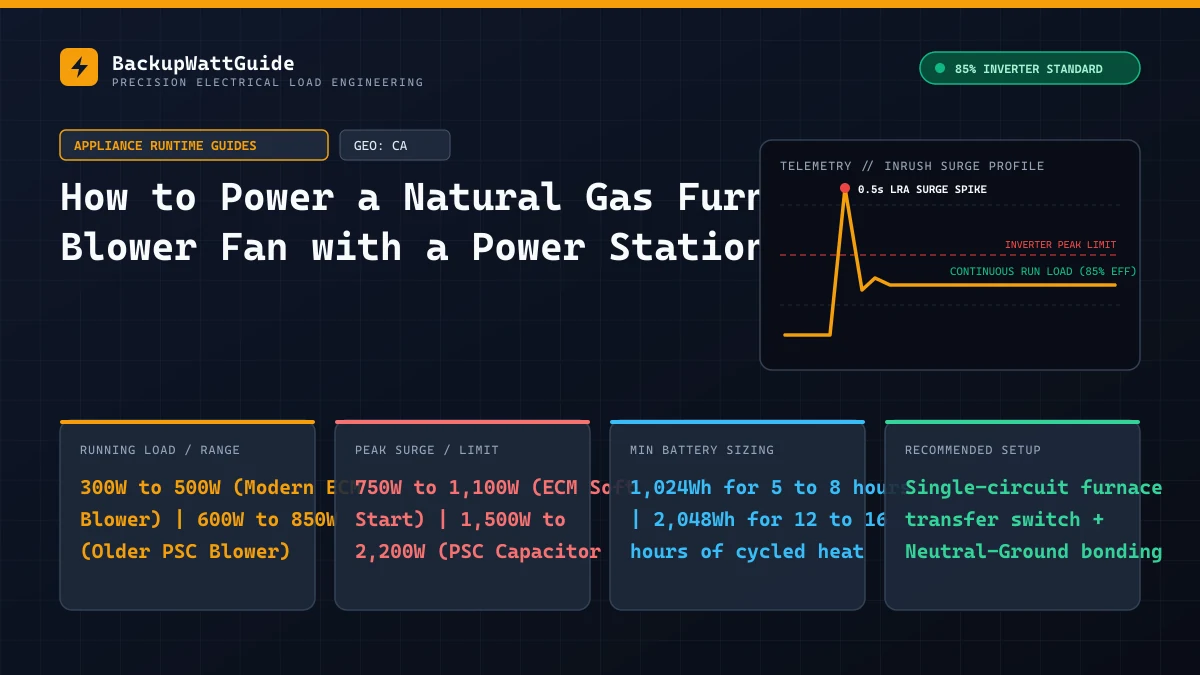
A natural gas or propane forced-air furnace produces 60,000 to 100,000 BTUs of heat per hour (equivalent to running fifteen 1,500W electric space heaters at once), yet it relies on a standard 120V 15-amp household circuit drawing just 350W to 800W to spin its air circulation blower, run the exhaust inducer fan, and glow the igniter. When an ice storm knocks out the grid, backing up that single 120V blower circuit with a portable power station keeps your entire house at 20°C (68°F) and prevents frozen copper water pipes.
Two things stop homeowners from running a gas furnace off a portable battery box on their first try. First, residential furnaces are hardwired into a metal junction box rather than equipped with a 3-prong wall plug. Second, even after you wire in a transfer switch or pigtail, plugging a modern furnace into a Bluetti, EcoFlow, Anker SOLIX, or Jackery station often results in the burner lighting for three seconds, shutting off, and flashing a flame rollout or ignition lockout code on the diagnostic LED window. Both problems take less than an hour to solve once you know how your furnace’s blower motor and flame rectification circuit work.
The 4 stages of a gas furnace heating cycle (and what each stage draws)
A forced-air gas furnace does not pull one flat wattage number from the moment your wall thermostat clicks on. Instead, the 24V control board steps through four distinct electrical phases over a 10-to-15-minute heating cycle:
| Furnace Cycle Stage | Duration per Cycle | Typical Power Draw (Watts) | What is Running Inside the Cabinet? |
|---|---|---|---|
| Stage 1: Draft Inducer Purge | 15 to 30 seconds | 45W – 85W | Small exhaust fan clears flue pipe and closes the vacuum pressure switch. |
| Stage 2: Hot Surface Igniter (HSI) | 17 to 35 seconds | 350W – 500W | Inducer fan + glowing silicon nitride igniter + 24V gas valve solenoid. |
| Stage 3: Burner Flame Warm-Up | 30 to 45 seconds | 55W – 90W | Igniter turns off; gas burners heat up the steel heat exchanger cells. |
| Stage 4: Main Air Handler Blower | 6 to 12 minutes | 300W – 500W (ECM Motor) 600W – 850W (PSC Motor) | Main squirrel-cage blower pushes warm air through house ductwork. |
Notice that Stage 2 (Hot Surface Igniter) and Stage 4 (Main Air Handler Blower) never run at the same time. The control board always shuts off the 400W igniter 30 seconds before energizing the main blower motor, which keeps your peak continuous demand lower than adding the components together.
ECM vs. PSC blower motors: Will a 1000W power station handle the startup surge?
Whether a 1,000W portable power station (with a 2,000W peak surge limit) can start your furnace depends on the age and motor type of the main air-handler blower sitting in the bottom compartment of your furnace:
1. Furnaces Built After ~2014: Brushless DC / ECM Motors (Low Surge)
To meet federal energy efficiency mandates in the US and Canada (such as the U.S. Department of Energy FER fan efficiency standards), nearly all modern high-efficiency condensing furnaces use an Electronically Commutated Motor (ECM)—including variable-speed and multi-speed X13 blowers.
- Startup behavior: Instead of slamming onto the 120V line all at once, the microprocessor inside an ECM motor ramps the fan wheel up smoothly over 4 to 8 seconds.
- Surge wattage: 700W to 1,050W (barely above its 320W to 480W running draw).
- Power station requirement: Any 1,000W continuous pure sine wave power station runs an ECM furnace blower effortlessly.
2. Older Furnaces (Pre-2014): Permanent Split Capacitor (PSC) Induction Motors (High Surge)
Older mid-efficiency furnaces (and base-model single-stage furnaces) use a heavy AC induction motor with a silver oval run capacitor strapped to the blower housing.
- Startup behavior: Just like the induction motor in our 1000W power station sump pump surge guide, a stationary PSC squirrel-cage blower pulls Locked Rotor Amps (LRA) of 13A to 19A for 0.5 seconds at startup.
- Surge wattage: 1,500W to 2,280W, settling down to 600W to 850W continuous running load.
- Power station requirement: A 1,000W station (2,000W peak) is borderline on a large 1/2 HP or 3/4 HP PSC blower used in 2,500+ sq ft homes and may trip an E01 inverter overload fault. For an older PSC blower, use a 1,500W to 1,800W continuous station (3,000W+ peak surge).
Solving the #1 failure: Floating neutrals and the flame sensor lockout
Here is the scenario that catches 90% of homeowners during their first blackout test: you wire a plug onto your furnace, plug it into your EcoFlow, Bluetti, or Anker power station, and turn up the thermostat.
- The draft inducer fan spins up normally.
- The hot surface igniter glows bright orange.
- The gas valve clicks open and blue flames ignite across the burners.
- Three seconds later, the gas valve slams shut, the flames go out, the furnace tries two more times, and the control board locks out with a flashing red LED meaning “Flame Sense Fault” or “Reversed Polarity / Bad Ground.”
Why a floating-neutral power station blinds the furnace flame sensor
Your furnace is not broken. Modern gas furnaces verify that the gas actually lit using a thin stainless steel rod called a Flame Rectification Sensor positioned right inside the burner flame.
- The furnace control board sends an alternating current (AC) signal of 80V to 120V onto that metal rod.
- Carbon ions inside the burning gas flame act like a diode, converting (rectifying) a tiny 1 to 6 microamp () DC current that flows from the rod, through the flame, into the metal burner manifold (connected to the green Equipment Ground wire), and back to the furnace control board’s White Neutral terminal.
- On normal utility grid power: Your home’s main breaker panel connects the White Neutral bus directly to the Green Ground bus via a copper bonding screw. That bond completes the return path so the microamp flame signal reaches the control board.
- On a standalone portable power station: To meet UL 2743 portable safety rules, unplugged portable power stations use an unbonded (floating) neutral. Inside the power station, the White Neutral slot and the Green Ground slot are completely isolated from each other. When the microamp signal from your burner flame enters the metal furnace cabinet (Ground), it has no bridge to get back onto the Neutral wire of the power station. The furnace computer sees
0.0 microamps, assumes unburned gas is pouring into your house without a flame, and shuts the gas valve down in 3 seconds.
The 5-second fix: Use a Neutral-Ground Bonding Plug (Only on standalone cords!)
Match your exact furnace connection method to the two rules below:
- If plugging the furnace directly into the power station via a single-circuit switch (like an EZ Generator Switch that switches both Hot and Neutral) or an appliance pigtail: Buy a $12 Neutral-Ground Bonding Plug (or wire a 12 AWG jumper between the silver Neutral screw and green Ground screw inside a hardware-store male replacement plug) and insert it into any open 120V AC socket on the front of your portable power station. That plug links Neutral and Ground inside the power station, giving the flame sensor its return path so the burners stay lit continuously.
- CRITICAL WARNING: Always pull that bonding plug out before plugging the power station back into a household wall outlet to recharge, or it will instantly trip your wall outlet—see our detailed explanation in why your power station trips GFCI outlets when charging.
- If powering the furnace through a whole-panel Reliance Pro/Tran2 6-circuit or 10-circuit transfer switch: Do NOT use a bonding plug! As explained in our walkthrough on connecting a portable power station to a manual transfer switch, multi-circuit panel switches leave the furnace’s white neutral wire connected to your main house breaker panel, so the furnace automatically keeps your house’s neutral-ground bond.
How to wire a gas furnace for battery backup (2 code-compliant methods)
Because residential electrical codes prohibit plugging a permanent furnace into a standard drywall receptacle, homeowners use one of two clean methods to isolate the furnace from the utility grid during an outage:
Method 1: Single-Circuit Manual Transfer Switch (EZ Generator Switch — Best for 1000W Stations)
Mounted right next to every gas furnace is a metal 4-inch junction box containing a standard toggle switch (often with a red faceplate) labeled FURNACE EMERGENCY SHUTOFF.
- An electrician (or experienced DIYer where permitted) replaces or supplements that junction box cover with a UL 1008 listed single-circuit manual transfer switch (such as the EZ Generator Switch).
- The front of the switch has a built-in male 3-prong NEMA 5-15P recessed inlet and a heavy toggle lever labeled
NORMAL (GRID)/OFF/GENERATOR. - How it operates: During 364 days of the year, the toggle sits on
NORMALand your furnace runs off the main house breaker panel. When a winter blackout hits, you plug a 12 AWG extension cord from your portable power station into the recessed inlet on the furnace box, plug your Neutral-Ground Bonding Plug into the second AC outlet on your power station, and flip the lever toGENERATOR. Because this switch disconnects both the Hot and Neutral wires from the main house panel, your power station is 100% isolated from the rest of the house.
Method 2: The 3-Prong Appliance Cord Conversion (Check Local Code Amendments)
In select municipalities where local code permits a dedicated cord-and-plug disconnect on a single-appliance circuit, the furnace junction box is fitted with a single Simplex 15A receptacle wired to the house breaker, and the furnace itself is wired with a 3-foot 14 AWG 3-prong appliance pigtail cord. During an outage, you unplug the furnace’s 3-prong cord from the junction box receptacle and plug it directly into your portable power station (with a bonding plug inserted in the station’s adjacent outlet).
Real-world winter runtime chart: How long will 1,000Wh to 2,000Wh heat your house?
Even in sub-zero weather, your gas furnace blower does not run 60 minutes out of every hour unless you set the thermostat to 24°C (75°F) in an uninsulated house. Setting your wall thermostat back to 17°C or 18°C (63°F–65°F) during a blackout cuts the furnace’s hourly duty cycle down to 25% to 35% (15 to 20 minutes of blower runtime per hour).
Compare total blackout heating hours across both Modern ECM and Older PSC furnace blowers on a 1,024Wh vs. 2,048Wh LiFePO4 station below (including an 85% inverter efficiency rating and 18W continuous AC inverter idle drain between cycles):
| Furnace Motor & Thermostat Duty Cycle | Active Blower Draw (Watts) | Blower Energy Used per Hour | Inverter Idle Lost per Hour | Total Hourly Drain (Wh/hr) | Runtime on 1,024Wh Station | Runtime on 2,048Wh Station |
|---|---|---|---|---|---|---|
| Modern ECM Blower (400W) Mild Winter: Runs 15 mins/hr (25%) | 400W | 100 Wh | +18 Wh | 118 Wh/hr | 7.4 Hours | 14.7 Hours |
| Modern ECM Blower (400W) Deep Freeze: Runs 30 mins/hr (50%) | 400W | 200 Wh | +18 Wh | 218 Wh/hr | 4.0 Hours | 8.0 Hours |
| Older PSC Blower (700W) Mild Winter: Runs 15 mins/hr (25%) | 700W | 175 Wh | +18 Wh | 193 Wh/hr | 4.5 Hours | 9.0 Hours |
| Older PSC Blower (700W) Deep Freeze: Runs 30 mins/hr (50%) | 700W | 350 Wh | +18 Wh | 368 Wh/hr | 2.4 Hours | 4.7 Hours |
Use the interactive calculator below to check your exact furnace runtime. To calculate cycled thermostat runtime rather than continuous blower operation, multiply your furnace’s running watts by your duty cycle before entering it into Appliance Running Watts (W) (for example, a 400W blower running 20 minutes per hour is average).
Real-World Battery Runtime Calculator (85% Inverter Efficiency)
3 settings to check before going to sleep during a winter blackout
- Switch the Wall Thermostat Fan Setting from
ONtoAUTO: Never leave your wall thermostat fan switch set toON(continuous air circulation) on battery power, or your blower motor will burn 400W to 700W for 60 minutes of every hour—draining a 1,024Wh battery dead in 75 minutes. Set the fan toAUTOso the squirrel-cage blower only runs when the gas burners are hot. - Disable Power Station ECO / AC Standby Timeout: Because your furnace draws 0 Watts during the 40 minutes per hour when the house is up to temperature, leaving ECO mode enabled on your power station will cause the battery to turn off its 120V AC outlets in the middle of the night. Set AC Standby Timeout to Never in your companion app.
- Keep the Power Station in a Warm Room (Not an Unheated Crawlspace): If your furnace sits in an unheated attic, garage, or crawlspace that drops below 0°C (32°F), keep the portable power station inside the heated living space and run a 12 AWG extension cord to the furnace switch. Below freezing, LiFePO4 batteries lose 15% to 25% of their usable capacity and lock out solar or generator recharging completely—see our winter battery guide on why your LiFePO4 power station won’t charge in freezing weather.
# Frequently Asked Questions
Why does my gas furnace ignite for 3 seconds and then shut off the gas valve when plugged into a portable power station?
Modern gas furnaces use a flame rectification rod that sends a tiny microamp AC current through the burner flame to the metal burner chassis and back to the control board along the equipment ground and neutral path. Because almost all portable power stations have a floating neutral, that return circuit is open. The furnace computer thinks the flame went out and closes the gas valve. Plugging a $12 neutral-ground bonding plug into an open AC socket on the power station closes the loop and fixes the error immediately.
Can I plug my gas furnace into a portable power station without cutting the hardwired house wiring?
No, residential building codes require gas furnaces to be hardwired to a dedicated 15-amp branch circuit rather than plugged into a standard wall receptacle, unless a local code amendment explicitly allows a dedicated cord-and-plug disconnect. The cleanest code-compliant solution is installing a UL-listed single-circuit manual transfer switch (such as an EZ Generator Switch) directly beside the furnace emergency shutoff switch.
How much battery power does the igniter use before the main blower fan turns on?
Most furnaces built after 2005 use a Silicon Nitride or Silicon Carbide Hot Surface Igniter (HSI) that glows orange before the gas valve opens. That igniter draws 300W to 450W of purely resistive power for 17 to 30 seconds at the start of every heating cycle, then shuts off before the main blower motor spins up.
Lead Technical Electrical Editor
Peer-ReviewedPower Systems Analyst & Backup Power Specialist
All technical guides and electrical sizing benchmarks are calculated using standard Nameplate Full Load Amps (FLA), Locked Rotor Amps (LRA) surge models, and an empirically verified 85% Inverter Power Factor & Conversion Efficiency model.