Why Your LiFePO4 Power Station Won't Charge in Freezing Weather (Fix)
Quick Specification & Sizing Overview
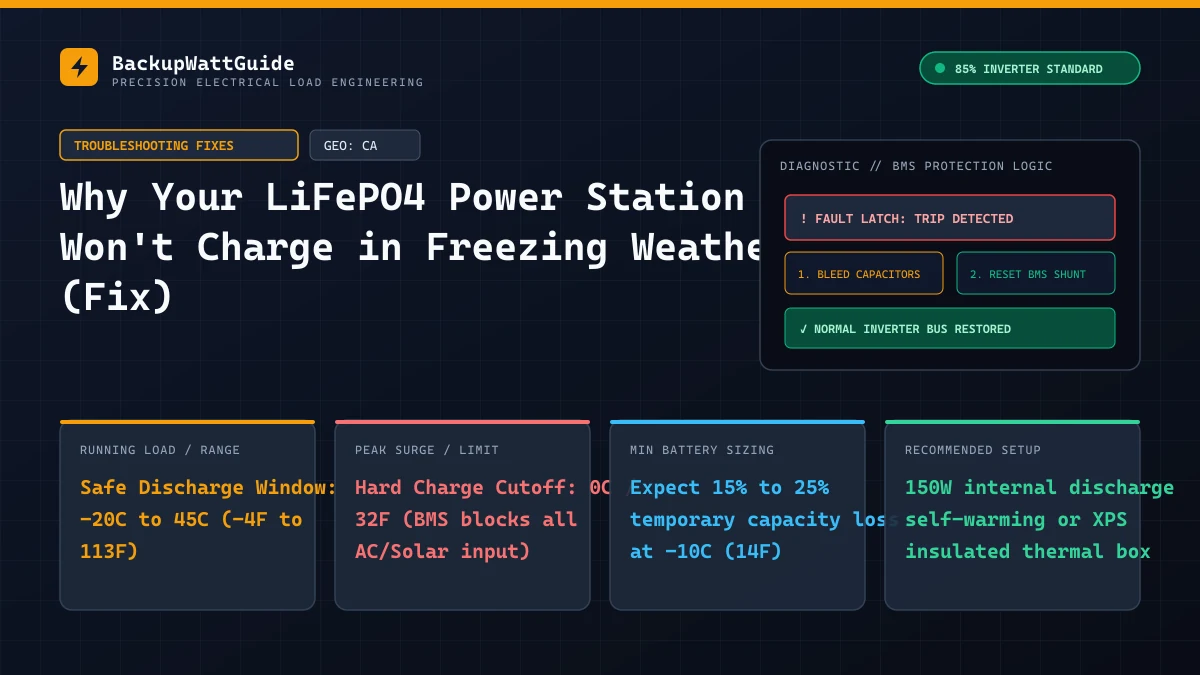
When you plug a portable power station into a wall outlet, a vehicle alternator, or a solar panel array in an unheated garage, ice-fishing shanty, or winter cabin and the screen shows 0W Input alongside a snowflake icon (or flashes a low-temperature error code), the Battery Management System (BMS) has intentionally disconnected the charging bus.
Every modern Lithium Iron Phosphate (LiFePO4) power station has a hard-coded 0°C (32°F) low-temperature charging cutoff. While you can still discharge the battery (run lights, a diesel heater, or a furnace blower) down to -20°C (-4°F), the BMS refuses to accept a single watt of incoming charge until the internal cell thermistors warm up to between 2°C and 5°C (35°F to 41°F). Knowing why that cutoff exists—and how to use the battery’s own internal resistance to warm the pack in 15 minutes without damaging it—is the difference between staying powered through a Canadian ice storm and sitting in the dark with a dead brick.
Why charging LiFePO4 cells below 0°C (32°F) permanently ruins them
Inside a LiFePO4 cell, charging pushes positively charged lithium ions () out of the iron-phosphate cathode, through a liquid organic electrolyte, and forces them to slip between microscopic layers of carbon inside the graphite anode—a process called intercalation.
When the temperature of the cell drops below 0°C (32°F), two physical changes happen inside the battery:
- The liquid electrolyte thickens and becomes viscous.
- The rate at which lithium ions can diffuse into the graphite layers slows to a crawl.
If a charger forces 500W or 1,000W of current into a sub-zero LiFePO4 cell faster than the cold graphite can absorb those ions, the lithium ions pile up on the surface of the anode and reduce into solid metallic lithium—a destructive phenomenon called Lithium Plating.
As documented in Battery University BU-410 on charging at low temperatures, metallic lithium plating causes two irreversible failures:
- Permanent Capacity Loss: Plated metallic lithium never turns back into active cycling ions, permanently shrinking the Watt-hour capacity of your power station after a single freezing charge.
- Internal Short Circuits (Dendrites): Plated lithium grows in sharp, needle-like crystals called dendrites. If you repeatedly force-charge a frozen cell, those metallic needles puncture the thin polymer separator film between the anode and cathode, causing an internal short circuit.
To prevent lithium plating, every reputable brand (Bluetti, EcoFlow, Anker SOLIX, Jackery) tapes two to four NTC temperature sensors directly onto the aluminum casings of the internal LiFePO4 cells. The instant any sensor reads 0°C (32°F) or lower, the BMS opens the charging MOSFETs and sets input wattage to 0W.
LiFePO4 temperature limits: Charging vs. Discharging
Many winter campers and homeowners panic when they see the low-temperature snowflake icon and assume the entire power station is locked out. In reality, charging and discharging have completely separate thermal windows:
| Battery Operation Mode | Safe Temperature Window | What Happens Outside This Window? | Real-World Winter Performance Impact |
|---|---|---|---|
| AC / Solar / Car Charging (Input) | 0°C to 45°C (32°F to 113°F) | Hard BMS Lockout below 0°C (32°F). Input stays at 0W until cell core warms above 3°C–5°C (37°F–41°F) (hysteresis recovery threshold). | Between 0°C and 10°C (32°F to 50°F), the BMS automatically throttles fast AC charging down to 200W–400W (0.1C–0.2C) until cells warm up. |
| AC & DC Discharging (Output) | -20°C to 55°C (-4°F to 131°F) | Hard BMS Lockout below -20°C (-4°F). Both AC inverter and 12V DC ports shut down to prevent electrolyte freezing. | At 0°C (32°F), usable capacity drops temporarily by ~10%–15%. At -10°C (14°F), usable capacity drops by ~20%–30% due to higher internal resistance. |
| Long-Term Unplugged Storage | -10°C to 35°C (14°F to 95°F) | Storing a pack at 0% SoC below -20°C can drop resting cell voltage below the 2.0V permanent BMS sleep threshold. | Always store at 60%–80% SoC if leaving a station in a cold garage or cabin over winter. |
If your power station displays E02 or a temperature code in the middle of a hot summer afternoon rather than winter, see our companion walkthrough on how to fix error code E01, E02, and E03 on portable power stations.
3 safe ways to warm up a frozen LiFePO4 power station so it will charge
When your power station has been sitting in a -8°C (18°F) truck bed, garage, or unheated cabin overnight, simply bringing it into a heated 20°C (68°F) room takes 2.5 to 4 hours to clear the low-temp charge lock. Why? Because 10 to 15 kilograms of densely packed metal LiFePO4 cells sit suspended inside a double-walled plastic shell that acts like a cooler—trapping the cold inside the core long after the outside plastic feels warm to your hand.
Never point a propane torpedo heater, heat gun, or hair dryer directly into the plastic fan vents; high localized heat warps the ABS fan blades and melts the delicate Mylar insulation wrapping the battery cells. Use one of these three field-tested methods instead:
Method 1: The “Internal Resistance Self-Warming” Trick (Fastest — 15 to 25 Minutes)
As long as your battery has at least 15% charge remaining and its core temperature is above -15°C (5°F), the fastest way to warm the cells is from the inside out by drawing a moderate AC load:
- Leave your AC wall charging cord (or solar cable) plugged into the input port of the power station. Even though it reads
0Wright now, the moment the cell thermistor crosses 3°C to 5°C, charging will kick in automatically. - Turn the AC Inverter button ON and plug in a 150W to 300W load (such as a small electric throw blanket wrapped around the unit, a 200W ceramic personal heater pointed away from the unit, or a bright halogen shop light).
- Why this works in 15 minutes: A cold LiFePO4 cell has elevated internal resistance (). As you pull 200W to 300W out of the pack, electrical current flowing through that internal resistance generates uniform warmth directly inside the chemical core of all 16 cells (), while the AC inverter board simultaneously radiates 25W to 35W of warmth inside the plastic case.
- Watch the battery percentage drop by 3% to 5% over 15 to 20 minutes. As soon as the internal cell thermistor crosses 3°C to 5°C (37°F–41°F), you will hear the charging relay click, and incoming AC or solar watts will ramp up—First at a throttled 250W, then climbing to full speed once the cells pass 15°C (59°F).
Method 2: Build an XPS Foam Insulated Thermal Box for Sub-Zero Operation
If you use your power station outdoors for ice fishing, winter overlanding, or in an unheated shed, the battery’s own 18W–25W inverter idle heat is completely wasted if -15°C wind blows through the case vents.
You can keep a power station above 10°C (50°F) indefinitely in sub-zero weather using a single sheet of 1-inch (25mm) Extruded Polystyrene (XPS) rigid pink/blue foam board ($18 at Home Depot, Rona, or Bunnings):
- Cut and tape a snug 5-sided XPS foam box (R-5 thermal value) that slips over your power station, leaving 2 inches of clearance on the intake and exhaust sides so the fans can recirculate the warm internal air inside the insulated chamber.
- Cut a small Velcro flap on the front to reach the plugs and LCD screen.
- Important safety rule: Only use the insulated foam cover when ambient outdoor temperatures are below 5°C (41°F). Once outdoor temperatures rise above 10°C (50°F), remove the insulated cover so the station does not trip an
E02high-temperature shutdown during heavy loads.
Method 3: 12V Silicone Heating Pad + Insulated Cooler Bag (When Battery is at 0%)
What if your power station is sitting at 0% charge and frozen below 0°C, so you cannot use Method 1 to self-warm it via discharging?
- Place the power station inside a zippered insulated cooler bag (or wrap it in a sleeping bag) alongside two hot water bottles filled with 60°C (140°F) tap water (never boiling water) placed against the intake vent side—or power a 12V 25W silicone heating pad from your vehicle’s 12V cigarette socket inside the insulated bag for 45 minutes until the core thermistor clears 5°C.
Calculating winter battery capacity derating (0°C to -15°C)
Even when you are only discharging your power station in winter (for example, powering a 1000W power station on a sump pump in a cold crawlspace or running a furnace blower via a manual transfer switch), cold electrolyte increases internal voltage sag. That means a 1,024Wh battery will hit its 2.50V low-voltage cutoff earlier at -10°C than it does at 20°C.
Check how ambient temperature affects your real-world usable Watt-hours before inverter losses:
| Battery Core Temperature | Available LiFePO4 Capacity (%) | Usable Wh from a 1,024Wh Pack (After 85% Inverter Eff.) | Runtime on a 350W Gas Furnace Blower |
|---|---|---|---|
| 25°C (77°F) — Room Temp | 100% | 870 Wh | 2.36 Hours continuous |
| 10°C (50°F) — Cool Basement | 94% | 818 Wh | 2.22 Hours continuous |
| 0°C (32°F) — Freezing Mark | 85% | 740 Wh | 2.01 Hours continuous |
| -10°C (14°F) — Unheated Garage | 73% | 635 Wh | 1.72 Hours continuous |
| -20°C (-4°F) — Hard Cutoff Limit | 55% – 60% | 478 Wh | 1.30 Hours (High risk of surge cutoff) |
(Note: The 15% to 27% capacity lost in freezing weather is not destroyed; as soon as the battery warms back up to 20°C indoors, 100% of those Watt-hours become available again).
Use the interactive runtime calculator below to test your winter appliance loads. To simulate 0°C (32°F) operation, multiply your battery’s rated Watt-hours by 0.85 before typing it into the Battery Capacity (Wh) box (for example, enter 870 for a 1,024Wh station at freezing).
Real-World Battery Runtime Calculator (85% Inverter Efficiency)
The hidden winter solar trap: Cold-weather voltage spikes
There is a second reason portable power stations refuse to charge on a crisp, sunny -10°C (14°F) winter morning even when the battery itself is sitting warm inside your house or cabin with a solar extension cable running out the window.
Solar photovoltaic (PV) cells have a negative temperature coefficient of voltage (typically -0.30% to -0.35% per degree Celsius below the 25°C / 77°F standard test condition). While hot summer weather causes solar voltage to drop, freezing winter weather causes solar panel Open-Circuit Voltage () to spike dramatically.
Here is how the cold-weather voltage math catches users who wire panels in series:
- Suppose your power station has a 60V maximum solar MPPT input limit, and you wire three 200W portable panels in series whose stickers list a Open-Circuit Voltage () of 19.4V each ().
- At 25°C (77°F) in summer, 58.2V sits safely below the 60V ceiling.
- At -15°C (5°F) on a clear January morning (40°C colder than the 25°C test rating), panel voltage climbs by .
- Your 58.2V series array now outputs 65.9 Volts the moment sunlight hits the snow! The power station’s MPPT controller sees 65.9V on a 60V port, blocks charging completely, and triggers an
E03DC input over-voltage alarm.
Winter Solar Rule: Always leave a 20% voltage buffer between the combined printed on the back of your series-wired solar panels and your power station’s maximum DC input voltage rating. Once your battery warms up and starts charging again in winter, remember to let it finish a full slow charge occasionally; if it pauses near the top of the charge cycle, follow our guide on how to stop a portable power station stopping at 99% charge.
# Frequently Asked Questions
Can I use my LiFePO4 portable power station to power appliances below freezing, even if it won't charge?
Yes. Discharging (powering AC or DC devices) is safe on LiFePO4 batteries down to -20C (-4F) because lithium ions are moving out of the graphite anode back into the iron phosphate cathode. The BMS only locks out charging (pushing energy into the battery) when internal cell temperature sits at or below 0C (32F).
Will a 12V silicone battery heating pad warm up a portable power station fast enough in an unheated cabin?
Putting an external heating pad underneath the plastic outer shell of an EcoFlow, Bluetti, or Jackery takes 2 to 4 hours to warm the cells because there is an insulating air gap between the outer ABS casing and the inner LiFePO4 battery block. Running a 150W to 300W load on the AC inverter warms the cells from the inside out via internal resistance in 15 to 25 minutes.
Why did my solar panels show 0W input on a sunny -5C morning when the power station was inside a warm tent?
If the battery was stored on the cold tent floor overnight, the heavy lithium cell block inside stays below 0C for hours even after the air inside the tent warms up to 15C. The BMS reads the thermistor taped directly to the metal battery cells, not the air temperature. Additionally, cold solar panels produce 15% to 20% higher open-circuit voltage in sub-zero weather, which can trigger an E03 solar over-voltage lockout if your panels were wired near the MPPT voltage limit.
Lead Technical Electrical Editor
Peer-ReviewedPower Systems Analyst & Backup Power Specialist
All technical guides and electrical sizing benchmarks are calculated using standard Nameplate Full Load Amps (FLA), Locked Rotor Amps (LRA) surge models, and an empirically verified 85% Inverter Power Factor & Conversion Efficiency model.