Why Your Power Station Trips GFCI Outlets When Charging (Ground Fix)
Quick Specification & Sizing Overview
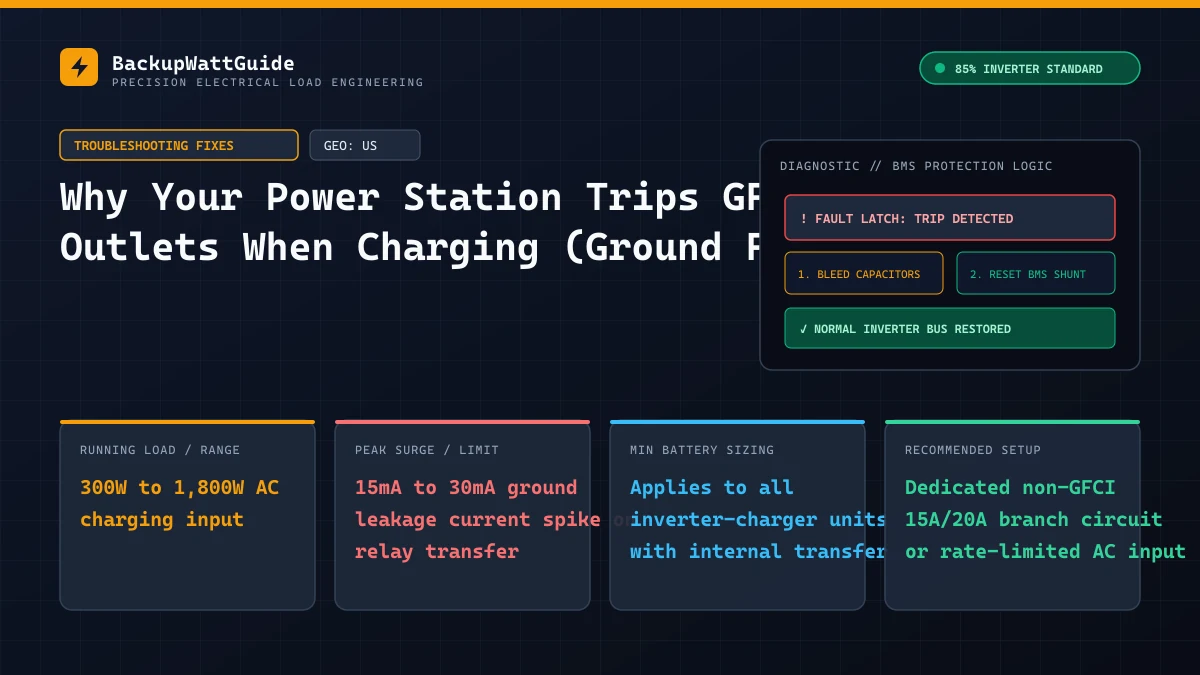
When you plug a Bluetti, EcoFlow, Anker SOLIX, or Jackery portable power station into a garage, basement, or kitchen wall socket to recharge and the wall outlet immediately clicks dead, the problem is almost never a short circuit inside your battery. What tripped the socket is a mismatch between the 5-milliamp (5mA) leakage ceiling of a North American Ground Fault Circuit Interrupter (GFCI) and the internal electromagnetic interference (EMI) filter capacitors and transfer relays inside fast-charging inverter-chargers.
Older portable power stations that charged through an external plastic power brick isolated the battery pack from the household AC neutral and ground lines. Modern LiFePO4 stations ditch the external brick in favor of an internal bi-directional inverter (such as EcoFlow X-Stream, Bluetti Turbo Charging, or Anker HyperFlash). That bi-directional board connects your household 120V hot, neutral, and ground wires directly to the station’s internal relay bus, creating three distinct ways to trip a sensitive GFCI receptacle.
How a 120V GFCI outlet detects a fault vs. what a power station actually does
A standard 15-amp or 20-amp circuit breaker in your main panel only cares about total current and heat; it will happily allow 14 amps to leak into a wet concrete floor without tripping. A GFCI receptacle (or AFCI/GFCI dual-function breaker) works differently. Inside the outlet sits a tiny differential current transformer ring surrounding both the black Hot wire and the white Neutral wire.
Under normal conditions, every electron flowing out of the black hot slot returns through the white neutral slot. If 8.000 amps leave on the hot wire and 8.000 amps return on the neutral wire, the magnetic fields inside the sensing ring cancel out to zero.
Under UL 943 standards for Class A GFCIs used across the United States and Canada, if the return current on the neutral wire drops by just 4mA to 6mA compared to the hot wire, the outlet assumes that missing current is leaking through a person’s body to ground and snaps the circuit open in less than 25 milliseconds. (In Australia and the UK, Residual Current Devices or RCDs use a higher 30mA trip threshold, which is why Australian 240V users rarely see this nuisance trip unless three or four appliances are chained together.)
The 3 technical causes of power station GFCI trips
Before moving cables around, match the exact moment your wall outlet clicks off to the three hardware scenarios below:
| When the Wall GFCI Trips | Root Electrical Cause | Fast Fix Summary |
|---|---|---|
| Scenario 1: Instantly (within 1 second) of plugging the AC charging cord into the wall | Y-Capacitor Inrush Leakage. The EMI filter capacitors wired between Hot/Ground and Neutral/Ground inside the power station dump a 6mA to 12mA current pulse into the green ground wire as they charge up. | Plug the cord into the power station first, then into the wall; or move to a 2020+ self-testing GFCI receptacle with high-frequency filtering. |
| Scenario 2: 5 to 15 seconds after plugging in (right when the power station clicks and ramps up wattage) | UPS Pass-Through Relay Switching. When the internal mechanical transfer relay switches the AC output bus over to grid bypass, a brief neutral-to-ground capacitance imbalance or a bonded-neutral load on the output side diverts neutral current onto the ground pin. | Unplug all 3-prong appliances (especially sump pumps, desktop PCs, or RV shore cords) from the front of the power station while wall charging. |
| Scenario 3: After 10 to 30 minutes of high-speed charging (1,200W to 1,800W) | Thermal or AFCI/GFCI Breaker Overload. Either the circuit is a dual-function AFCI/GFCI breaker mistaking the power factor correction (PFC) switching noise for an arc fault, or continuous 15A draw heated an aging GFCI spring contact. | Drop the AC charging speed slider in the companion app from 1,500W/1,800W down to 400W–600W. |
If your wall outlet stays on, but the power station itself flashes an overload code on its screen and shuts down its ports, you have an internal inverter latch rather than a wall ground fault. Follow our diagnostic guide on how to fix error code E01, E02, and E03 on portable power stations instead.
Fix 1: Eliminate Y-capacitor ground leakage during plug-in
Every bi-directional inverter-charger uses high-frequency switching transistors operating at 20 kHz to 50 kHz. To pass FCC Part 15 emissions testing and prevent that switching noise from turning your house wiring into a giant radio antenna, engineers solder ceramic Class Y safety capacitors between the AC Hot line and chassis Ground, and between AC Neutral and chassis Ground.
Because capacitors pass alternating current, those Y-capacitors intentionally bleed 1.5mA to 3.5mA of continuous AC current onto the third (ground) prong during normal operation. That sits just beneath the 4mA–6mA trip threshold of a healthy GFCI outlet.
However, when you plug the charging cable into the wall while the capacitors are completely empty, the initial surge into those Y-capacitors spikes above 8mA for a few milliseconds. If your garage or basement GFCI outlet is already guarding a long branch circuit with a freezer, a dehumidifier, or damp concrete conduit (which adds 2mA of background capacitive leakage of its own), that tiny plug-in spike pushes total leakage past 6mA and trips the button.
Step-by-step workaround for Scenario 1
- Unplug every other 3-prong appliance on that same GFCI branch circuit. A single GFCI outlet in a garage often protects four or five regular outlets downstream (wired to its
LOADterminals). If a garage chest freezer and an LED shop light are plugged into downstream outlets on the same circuit, their EMI filters are already eating 2.5mA of your 5mA leakage budget. - Connect the C13/C19 cable to the power station before plugging the NEMA 5-15P plug into the wall. Sparking the connection at the power station inlet while the cord is already live creates contact bounce, multiplying high-frequency current spikes through the Y-capacitors.
- Swap 15-year-old GFCI receptacles for modern UL 943 self-testing units. First-generation GFCI outlets installed in the 1990s and 2000s suffer from weakened sensing coils and lack high-frequency low-pass filters. A $18 Leviton SmartlockPro or Eaton commercial-grade 20A GFCI filters out high-frequency EMI hash above 1 kHz, stopping false trips from inverter chargers.
Fix 2: Stop UPS pass-through neutral-ground loops (Scenario 2)
The most common complaint on Reddit and support forums happens when a homeowner tries to use a portable power station as a permanent inline Uninterruptible Power Supply (UPS) for a 1000W power station running a basement sump pump, a chest freezer, or a home server rack.
Here is why inline UPS mode trips GFCI outlets after 5 to 10 seconds:
- You plug the power station into the basement GFCI wall outlet.
- Five seconds later, the power station recognizes grid power, clicks its internal double-pole or single-pole bypass relay, and connects the wall outlet directly through to the power station’s front AC sockets while tapping power to charge the LiFePO4 cells.
- If you have an appliance plugged into the front of the power station—or worse, if you left a Neutral-Ground Bonding Plug inserted in one of the station’s AC sockets—a parallel return path forms immediately.
Why a neutral-ground bonding plug guarantees a GFCI trip while charging
Most portable power stations feature a floating neutral when running purely on battery power. That is safe for plug-in tools, but certain appliances—like residential gas furnaces with flame-rectification sensors or EcoFlow/Bluetti units hooked up to RV surge protectors—refuse to run on a floating neutral and demand a $12 neutral-ground bonding plug.
A bonding plug contains a simple jumper wire connecting the Neutral slot directly to the Ground pin.
- When unplugged from the wall (Battery Mode): The bonding plug safely creates an isolated neutral-ground bond at the inverter.
- When plugged into the wall (AC Charging / Pass-Through Mode): Your house already has a primary Neutral-to-Ground bond inside the main 200A breaker panel. If you leave a bonding plug inside the power station while plugging the power station into a wall GFCI outlet, neutral return current splits in half: 50% flows back on the white Neutral wire, and 50% flows back on the bare copper Ground wire. The wall GFCI sees half the current missing from the sensing coil and trips within 10 milliseconds.
Rule for home backup users: Always pull your neutral-ground bonding plug out of the power station’s AC strip before plugging the charging cord into a wall outlet. If you are connecting your battery to household circuits via a transfer panel, read our dedicated wiring rules on wiring a portable power station to a manual transfer switch.
Fix 3: Stop AFCI/GFCI nuisance trips during 1,500W+ fast charging (Scenario 3)
In newer homes built under recent editions of the NFPA 70 National Electrical Code (NEC), bedrooms, living rooms, kitchens, and laundry areas are protected by Dual-Function AFCI/GFCI circuit breakers in the main panel (distinguished by purple or blue “TEST” buttons).
An Arc Fault Circuit Interrupter (AFCI) does not just watch for ground leakage; a microprocessor inside the breaker continuously monitors the sine wave for high-frequency current signatures that look like a sparking wire inside a wall.
When a 1,000Wh to 2,000Wh power station ramps up to 1,400W–1,800W AC input (pulling 12A to 15A continuous on a 15A circuit), its active Power Factor Correction (PFC) boost converter chops the incoming 60Hz sine wave thousands of times per second. Older Siemens, Square D, and Eaton AFCI breakers frequently misinterpret that 1,500W PFC switching ripple as a series arc fault, tripping the breaker 10 to 20 minutes into the charge cycle.
How to calculate your safe charging wattage ceiling
Lowering your AC input wattage in the Bluetti, EcoFlow, or Anker mobile app accomplishes two things at once: it cuts high-frequency PFC switching noise in half, and it stops thermal creep in 15-amp wall receptacles.
Use the interactive calculator below to see how dropping your appliance or charging load impacts continuous system runtimes and thermal margins.
Real-World Battery Runtime Calculator (85% Inverter Efficiency)
Follow these exact app settings to stop Scenario 3 breaker trips:
| Circuit Type & Location | Max Continuous Safe Load (80% NEC Rule) | Recommended App AC Charge Setting | Time to Charge a 1,024Wh Pack (0–100%) |
|---|---|---|---|
| 15A Shared Basement / Garage GFCI (with freezer or lights on circuit) | 1,440W total across all outlets | 400W to 600W (Silent / Standard Mode) | 1.9 to 2.7 Hours |
| 15A Dedicated Interior Outlet (on AFCI/GFCI dual breaker) | 1,440W | 800W to 1,000W | 1.1 to 1.4 Hours |
| 20A Dedicated Workshop Circuit (NEMA 5-20R T-slot outlet) | 1,920W | 1,200W to 1,600W | 45 to 60 Minutes |
Lowering your AC charge rate to 400W–600W also stops the battery cells from overheating in summer and improves top-end cell balancing. If your battery frequently pauses at 98% or 99% when fast charging at 1,500W, slow charging is the exact remedy covered in our guide on stopping at 99% charge during calibration.
Why you should never use a 3-prong to 2-prong “cheater” adapter
Across dozens of camping and solar forums, users recommend slipping a $1.50 gray 3-prong-to-2-prong grounding adapter onto the power station’s charging cord so the ground pin never touches the wall outlet.
While severing the ground pin physically stops Y-capacitor leakage from returning through the outlet’s ground path, it creates two real hazards:
- Energized Chassis Hazard: During AC fast charging or pass-through UPS operation, the power station’s internal inverter board is tied directly to 120V grid potential. If you lift the ground prong with a cheater plug, the internal EMI filter capacitors instantly float the metal chassis and USB/DC ground shields of the power station to 60V AC relative to earth (a classic capacitive voltage divider between the two Y-capacitors). Touching the metal shell of a USB-C cable plugged into the station while standing barefoot on a concrete basement floor will deliver a sharp, painful tingle—and if an internal hot wire ever faults to the frame, the wall GFCI will not trip until you touch the unit and become the path to ground.
- Voided Surge Protection: The internal metal-oxide varistors (MOVs) that protect your $800 power station from grid lightning spikes divert excess voltage into the equipment grounding conductor. With the ground prong lifted on a 2-prong adapter, grid voltage transients have nowhere to dump energy except straight through your main BMS control board.
Permanent solutions when your only outlet is a tripping GFCI
If you live in an apartment or house where every reachable garage or basement outlet trips at even 400W AC input, use one of these three code-compliant fixes:
- Option 1: Charge via the DC MPPT port using an isolated AC-to-DC bench power supply. Every portable power station has an XT60, XT90, or DC7909 solar/car input port that is galvanically isolated from the AC inverter relay bus. Plugging a UL-listed 24V or 48V AC-to-DC switching power brick (or the manufacturer’s official external “T500” style AC adapter brick) into the solar port isolates the station’s internal Y-capacitors and bypass relay completely, drawing 300W to 500W from any GFCI outlet with zero nuisance trips.
- Option 2: Run a heavy-duty 12 AWG extension cord to a non-GFCI living room or hallway circuit. Interior living areas, hallways, and home offices sit on standard circuit breakers rather than wet-location Class A GFCIs. Always use a 12 AWG (or 10 AWG) cord under 25 feet so voltage drop does not trigger a low-voltage charging fault on the station.
- Option 3: Have an electrician install a dedicated single-receptacle circuit for backup equipment. In many jurisdictions adopting amended NEC rules, or when installing a dedicated receptacle next to a transfer panel, a licensed electrician can advise on commercial-grade GFCI devices with tighter EMI filtering or dedicated branch circuits that isolate your battery charger from noisy induction motors on the rest of the basement loop.
# Frequently Asked Questions
Is it safe to use a 3-prong to 2-prong cheater plug to stop my power station from tripping a GFCI outlet?
No. Lifting the safety ground with a 2-prong adapter defeats the chassis ground bond between the power station and your house panel. If an internal high-voltage wire chafes against the metal inverter frame, the casing can stay energized at 120V without tripping a breaker. Instead of lifting the ground, plug into a standard non-GFCI interior receptacle or lower the AC charging amperage in the app.
Why does my power station charge fine on a kitchen GFCI outlet until I plug an appliance into the power station?
When you plug a 3-prong appliance into the AC outlets of a charging power station, the station activates pass-through UPS mode. If that appliance has its own EMI filter capacitors or a neutral-to-ground reference (like a desktop PC power supply or a refrigerator compressor), the combined leakage current across both EMI filters exceeds the 5-milliamp trip threshold of a North American Class A GFCI receptacle.
Does buying a neutral-ground bonding plug fix a power station that trips a wall GFCI while charging?
No. A neutral-ground bonding plug is used on the output side of a floating-neutral power station so sensitive appliances like gas furnaces or RV surge protectors will run during an outage. Plugging a bonding plug into a power station while that station is simultaneously plugged into a wall GFCI outlet will guarantee an instant GFCI trip because it creates a parallel path for neutral return current on the equipment grounding conductor.
Lead Technical Electrical Editor
Peer-ReviewedPower Systems Analyst & Backup Power Specialist
All technical guides and electrical sizing benchmarks are calculated using standard Nameplate Full Load Amps (FLA), Locked Rotor Amps (LRA) surge models, and an empirically verified 85% Inverter Power Factor & Conversion Efficiency model.