Can a 1500W Power Station Boil a 240V Kettle in Australia? (Test)
Quick Specification & Sizing Overview
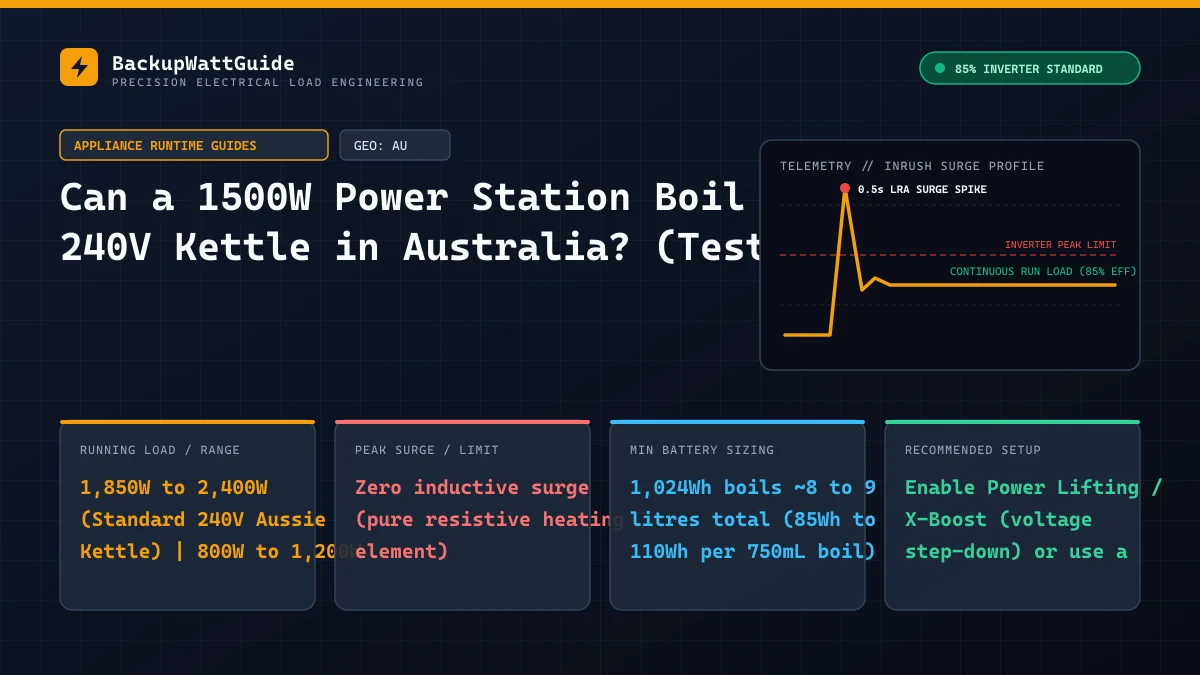
In North America, standard 120V kitchen kettles are capped at 1,500 Watts because household outlets are limited to 15 Amps (). In Australia, New Zealand, and the UK, standard 230V–240V household sockets supply up to 10 Amps (2,400W), which means almost every domestic kettle sold at Kmart, Big W, Target, or Harvey Norman packs a 2,000W to 2,400W heating element.
When an Australian camper packs the 2,200W kettle off their kitchen bench and plugs it into a mid-size 1,500W or 1,800W portable power station (like an EcoFlow DELTA 2, Bluetti AC180, Anker SOLIX C1000, or iTechworld PS1500), one of two things happens: either the power station trips immediately into an E01 overload fault, or you turn on X-Boost / Power Lifting mode and watch the kettle boil at reduced voltage.
Here is the exact electrical math behind running a 240V kettle on a 1,500W–1,800W inverter, why Ohm’s Law allows voltage-throttling modes to tame a 2,200W element safely, and how many Watt-hours you burn per cup of coffee off-grid.
Why Australian 240V kettles trip 1,500W inverters (and how Power Lifting cheats Ohm’s Law)
Unlike a 40L Engel 12V camping fridge or a motor-driven water pump, an electric kettle has zero inductive startup surge. The heating element embedded in the base of the jug is a simple nichrome resistor with a fixed electrical resistance ().
Let’s look at the resistance of a standard 2,200W, 240V Australian kettle using Ohm’s Law ():
That 26.18-Ohm physical resistance is permanently fixed inside the metal coil of the kettle.
- When you plug that 26.18-Ohm kettle into a normal 240V AC inverter, it tries to pull , which equals 2,200 Watts. If your portable power station has a hard 1,500W or 1,800W continuous inverter limit with standard protection enabled, the BMS trips an overload shutdown within two seconds (see our guide on clearing E01, E02, and E03 error codes).
- What happens when you enable Bluetti “Power Lifting”, EcoFlow “X-Boost”, or Anker “SurgePad”: Instead of shutting off, the inverter’s digital signal processor intentionally drops the AC output voltage from 240V down to ~198V (on an 1,800W station) or ~180V (on a 1,500W station).
Look at what happens to the wattage of that exact same 26.18-Ohm kettle when the power station lowers the voltage to 195 Volts:
By stepping the voltage down by 19%, the power station cuts the kettle’s power draw by 34% (from 2,200W down to 1,452W), keeping the load safely inside the 1,500W inverter ceiling until the water hits 100°C and flips the steam bi-metal switch off!
Boil time and Watt-hour test table: 2,200W Kettle vs. 1,000W Travel Kettle
A common myth on camping forums is that using a lower-wattage 1,000W travel kettle—or using X-Boost to throttle a 2,200W kettle down to 1,450W—“saves battery Watt-hours” compared to boiling at a full 2,200W.
Physics says the opposite. Raising 1.0 Litre of water from 20°C (68°F) to a 100°C (212°F) rolling boil requires a fixed amount of thermal energy ():
Whether you put that 93 Wh of heat into the water in 2.5 minutes at 2,200W or 6 minutes at 1,000W, the water itself absorbs the exact same 93 Wh! In fact, a slower boil uses slightly more battery capacity because the hot kettle walls radiate heat into the chilly morning air for an extra three minutes while the inverter burns idle power.
Compare real-world boil times and battery drain for 750 mL of water (3 large mugs of coffee) from a 20°C start on a 1,024Wh LiFePO4 power station (incorporating our 85% inverter efficiency standard):
| Kettle Type & Inverter Mode | Actual Operating Voltage & Watts | Time to Boil 750 mL (3 Mugs) | Battery Wh Used per 750 mL Boil | % of a 1,024Wh Battery Used | Total 750 mL Boils per Full Charge |
|---|---|---|---|---|---|
| Standard 2,200W 240V Kettle (On a 2,400W Native Inverter — Full 240V) | 240V AC @ 2,200W | 2 mins 15 secs | ~82 Wh (96 Wh from battery) | 9.4% | 10.6 Boils (~32 mugs) |
| Standard 2,200W 240V Kettle (On 1,800W Station w/ Power Lifting ON) | ~210V AC @ 1,680W | 2 mins 58 secs | ~83 Wh (98 Wh from battery) | 9.6% | 10.4 Boils (~31 mugs) |
| Standard 2,200W 240V Kettle (On 1,500W Station w/ X-Boost ON) | ~192V AC @ 1,410W | 3 mins 35 secs | ~84 Wh (99 Wh from battery) | 9.7% | 10.3 Boils (~30 mugs) |
| Low-Wattage 240V Camping Kettle (Kmart / Companion 1,000W–1,200W Jug) | 240V AC @ 1,100W | 4 mins 40 secs | ~86 Wh (101 Wh from battery) | 9.9% | 10.1 Boils (~30 mugs) |
| 12V DC Cigarette Socket Kettle (12V 10A / 120W Plug-In Car Mug) | 12.6V DC @ 115W | 38 to 45 mins! | ~88 Wh (High heat loss through walls) | 8.6% | Not Recommended (Melts 12V plugs) |
Use the calculator below to check how your kettle wattage interacts with your battery capacity. Remember that 1.00 Hours on the display equals 60 minutes of continuous boiling (divide total minutes by 3.5 to see how many 3.5-minute kettle boils you get on a full charge):
Real-World Battery Runtime Calculator (85% Inverter Efficiency)
Which 240V kettles work with Power Lifting / X-Boost (and which ones fail)
If your portable power station is rated for 1,200W, 1,500W, or 1,800W continuous output and you plan to rely on Bluetti Power Lifting, EcoFlow X-Boost, or Anker SurgePad to run a 2,200W domestic kettle, you must choose the right style of kettle:
1. Mechanical Bi-Metal Switch Kettles (100% Compatible)
Any basic 40 kettle with a physical mechanical lever under the handle (or at the base) that clicks down manually and pops back up when steam hits a bi-metal strip inside the handle works flawlessly on reduced voltage. Because there is no computer board inside the base, the heating coil happily accepts 185V or 200V and boils water without complaint.
2. Electronic “Keep Warm” and Variable-Temp Smart Kettles (Will Fail!)
If your kettle has a digital temperature display (60°C, 80°C, 90°C, 100°C buttons for green tea and pour-over coffee) or an electronic soft-touch power pad in the base, Power Lifting and X-Boost will cause it to malfunction.
- Electronic kettles use a 5V/12V switching power supply on a printed circuit board to hold an internal electromagnetic relay closed while the element heats.
- The instant the relay closes and the 2,200W element pulls current, your power station drops the line voltage from 240V down to 185V.
- The kettle’s microcontroller detects a 55-Volt drop on the 240V line, resets its screen (or flashes an under-voltage beep), and opens the relay! One second later, voltage jumps back up to 240V, and the kettle clicks on and off in a loop without ever boiling.
Rule for Smart Kettles & Coffee Machines: If you want to run an electronic variable-temperature kettle or an espresso machine with a vibratory water pump (like a Breville Bambino or Barista Express), you cannot use voltage-reduction modes. You must either use a power station whose native continuous wattage exceeds 2,200W (such as a 2,400W Bluetti AC200L or EcoFlow DELTA 2 Max), or pack a dedicated 1,000W to 1,200W low-wattage camping kettle that runs at full 240V without triggering voltage step-down.
3 rules before enabling Power Lifting / X-Boost at camp
- Unplug Every Other 240V Appliance First: Never leave a laptop charger, Starlink dish, or induction charger plugged into the adjacent 240V sockets on your power station when boiling a 2,200W kettle in Power Lifting mode. Because the power station intentionally browns out the entire 240V AC bus down to ~185V for 3.5 minutes during the boil, any other appliance plugged into the neighboring AC socket is forced to endure that 185V brownout at the same time! (Your 12V DC sockets—where your 40L Engel camping fridge is plugged in—stay on an isolated regulated 12V bus and are completely unaffected by 240V Power Lifting).
- Only Boil the Exact Amount of Water You Are Drinking: Every extra 250 mL (1 cup) of water you leave sitting in the bottom of the kettle burns an extra 28 Watt-hours (~3% of a 1,000Wh battery) for nothing. Measure your water with your coffee mug before pouring it into the kettle.
- Recharge Those 95 Watt-Hours Straight Back via Solar: One 750 mL morning kettle boil uses ~95 Wh from your battery. If you have a 200W solar blanket plugged in via a high-current Anderson to XT60i solar charging cable, just 40 minutes of morning sunshine puts all 95 Wh straight back into your LiFePO4 cells before you finish packing up camp. (If your solar panels seem to stall below 120W on a scorching 40°C afternoon, see our troubleshooting guide on why solar panels drop wattage in 40C Outback heat).
# Frequently Asked Questions
Will running a 2,200W 240V kettle on a 1,500W or 1,800W power station using Power Lifting damage the kettle?
No, as long as your kettle is a simple mechanical switch model without a digital LCD temperature controller. Power Lifting (Bluetti), X-Boost (EcoFlow), and SurgePad (Anker) lower the AC output voltage from 240V down to roughly 185V–200V so a 2,200W heating element only pulls 1,400W to 1,500W. Because a kettle heating coil is a pure resistor, running it at 190V is completely harmless; it simply takes 4.5 minutes to boil instead of 3 minutes.
Why did my smart variable-temperature kettle beep and shut off when I turned on EcoFlow X-Boost or Bluetti Power Lifting?
Smart kettles with digital buttons (such as Breville Smart Kettles or Fellow Stagg EKG units) contain a low-voltage logic board and a relay or triac that monitors incoming mains voltage. When X-Boost drops line voltage from 240V down to 190V to cap the wattage, the kettle's computer detects a severe brownout and shuts off its relay. Only mechanical flick-switch kettles work with voltage-reduction modes.
Is it more efficient to boil water with a 12V car cigarette plug kettle or a 240V AC kettle on a portable power station?
Always use a 240V AC kettle. A 12V cigarette socket is limited to 120W (10 Amps), meaning a 12V kettle takes 35 to 45 minutes to bring 500mL of water to a boil. During those 40 minutes, heat radiates out through the plastic walls of the jug into the air faster than the weak 120W element can add it, wasting more battery Watt-hours than a fast 3-minute 240V boil.
Lead Technical Electrical Editor
Peer-ReviewedPower Systems Analyst & Backup Power Specialist
All technical guides and electrical sizing benchmarks are calculated using standard Nameplate Full Load Amps (FLA), Locked Rotor Amps (LRA) surge models, and an empirically verified 85% Inverter Power Factor & Conversion Efficiency model.