Why Solar Panels Drop Wattage in 40C Outback Heat (MPPT Fix)
Quick Specification & Sizing Overview
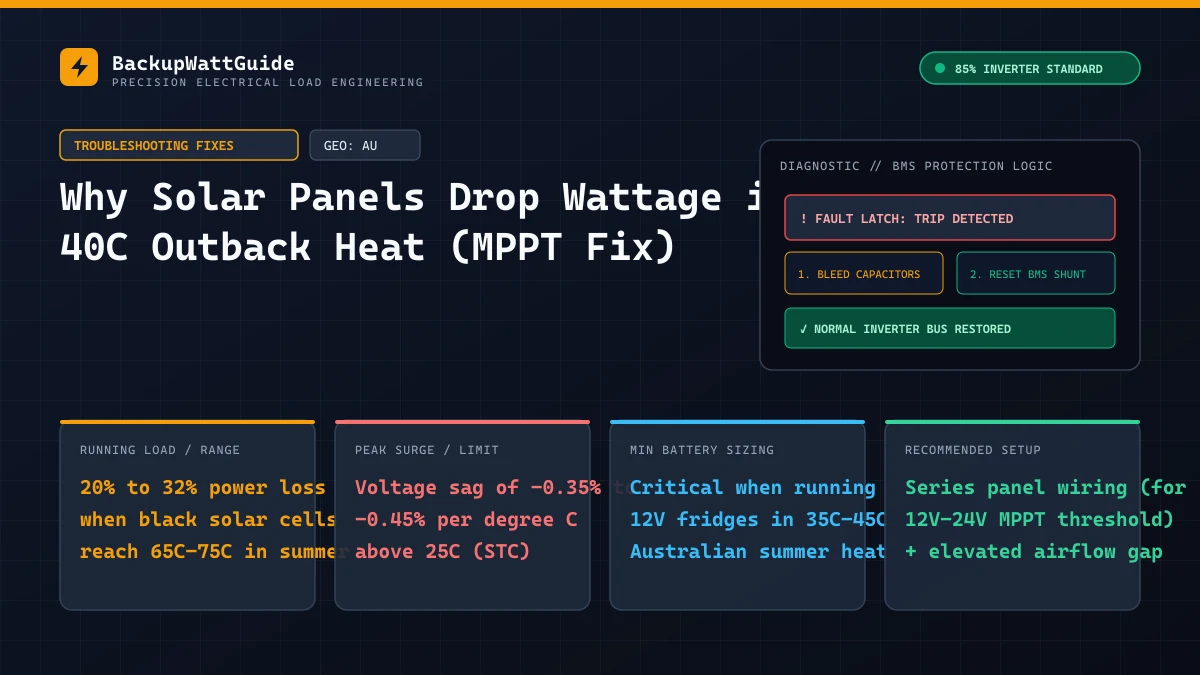
It is the most frustrating paradox in off-grid camping and home solar backup: on a crisp, cool 16°C (60°F) April or October morning, your 200W portable solar panel easily pumps 165W to 180W into your Bluetti, EcoFlow, Anker SOLIX, or iTechworld power station. Yet when you set that exact same 200W panel out under a blazing, cloudless sky in 38°C to 42°C (100°F to 108°F) Australian Outback or desert summer heat—right when your 40L Engel camping fridge is working its hardest—the LCD screen on your power station struggles to pass 105W to 120W, or worse, drops to 0W in the middle of the afternoon.
Your solar panel is not defective, and the sun isn’t weaker. What is robbing 25% to 35% of your charging wattage is semiconductor voltage collapse from extreme cell heat, compounded by line resistance in long extension cables and the minimum MPPT turn-on voltage of your power station.
The 25°C STC rating illusion: Air temperature vs. actual solar cell temperature
Every portable solar panel sold worldwide has its wattage (200W), Working Voltage (), and Open-Circuit Voltage () measured inside an air-conditioned factory flash-tester under Standard Test Conditions (STC):
- 1,000 W/m² solar irradiance
- 25°C (77°F) actual silicon cell temperature (achieved by flashing a xenon lamp for 10 milliseconds in a cool room so the panel cannot warm up).
Out in the bush or on a suburban patio, a solar panel is a matte-black heat absorber. Under full midday sunshine with gentle wind, the silicon cells inside a portable solar panel always run 25°C to 35°C hotter than the surrounding shade air temperature:
- On a mild 20°C (68°F) day, your solar cells are already sitting at 45°C to 50°C (113°F–122°F).
- On a scorching 40°C (104°F) Australian summer afternoon, a dark folding solar blanket laid on the ground or draped over a 4WD bullbar reaches an actual cell temperature of 68°C to 78°C (154°F to 172°F)—more than 50°C hotter than the factory test sticker on the back of the panel!
How the Temperature Coefficient ( & ) kills summer wattage
Silicon photovoltaic cells are semiconductor diodes. As a semiconductor heats up, electrons require less energy to jump the bandgap, which slightly increases current (+0.04%/°C) but severely drops voltage (-0.32% to -0.40% per °C) and net wattage (-0.38% to -0.45% per °C).
Check the specification sheet from the Clean Energy Council or your panel manufacturer for the Temperature Coefficient of (typically -0.40% / °C for portable monocrystalline panels). Here is the exact formula for heat loss:
Look at what happens to a high-end 200W portable solar panel (rated at 18.0V at 25°C) as ambient air temperatures climb from a cool morning to a 42°C afternoon:
| Ambient Shade Air Temp | Actual Black Solar Cell Temp | Degrees Above 25°C STC | Voltage Drop (-0.35%/°C on 18.0V Panel) | Real-World Working Voltage () | Real-World Max Output from 200W Panel (Before Angle/Dust) |
|---|---|---|---|---|---|
| 10°C (50°F) (Cold Morning) | 25°C (77°F) | 0°C | 0.00V (0%) | 18.0V | ~175W – 185W (Peak real-world efficiency) |
| 25°C (77°F) (Mild Spring Day) | 52°C (125°F) | +27°C | -1.70V (-9.5%) | 16.3V | ~148W – 155W |
| 35°C (95°F) (Hot Summer Day) | 65°C (149°F) | +40°C | -2.52V (-14.0%) | 15.5V | ~130W – 138W |
| 42°C (108°F) (Outback / Canopy) | 75°C (167°F) | +50°C | -3.15V (-17.5%) | 14.8V | ~115W – 122W |
| 42°C (108°F) (Flat on Hot Car Bonnet) | 85°C (185°F) | +60°C | -3.78V (-21.0%) | 14.2V | ~98W – 105W (Or drops to 0W — see below!) |
Why solar input suddenly drops to 0W at 1:00 PM (The MPPT Voltage Floor Trap)
Losing 20% of your wattage to heat is annoying, but losing 100% of your charging (0W Input) at peak heat happens because of the fifth column in the table above: your panel’s Working Voltage () sagging from 18.0V down to 14.2V.
Inside your portable power station sits a Maximum Power Point Tracking (MPPT) controller that requires a minimum starting voltage to operate:
- Bluetti AC180 / EB70S: Minimum MPPT Range starts at 12V (and only unlocks full current greater than 8A above 15V–16V or 32V depending on model).
- EcoFlow DELTA 2 / River Series: Minimum MPPT Range starts at 11V, but requires input voltage to remain sustainably above the internal step-up converter floor.
- 24V / 48V Power Stations & Certain Hybrid Inverters: Require 17V to 20V minimum just to wake up the MPPT charging relay!
Now trace what happens on a 40°C afternoon when you use a single “12V nominal” (18V ) folding solar blanket on the end of a cheap 6-metre extension lead:
- The 75°C cell heat drops your solar blanket’s output voltage from 18.0V down to 14.8V right at the panel junction box.
- As the panel tries to push 8 Amps down your 6-metre extension cable, wire resistance drops another 1.2V to 1.8V along the cord (unless you built a thick 10 AWG / 12 AWG cable using our guide on wiring an Anderson plug to XT60 for Bluetti and EcoFlow).
- Voltage arriving at the power station’s XT60 port falls to 13.0V.
- The MPPT controller inside your power station tries to pull current, pulls the sagging voltage below its threshold, resets to
0W, sees open-circuit voltage bounce back up to 16V, tries to engage again, and gets stuck in a 15W -> 0W -> 15W hunting loop all afternoon!
4 field fixes to recover 30% to 50% more solar wattage in 40°C heat
You cannot change the ambient temperature of the Simpson Desert or Arizona in July, but you can change panel voltage architecture and backside convective cooling in five minutes:
Fix 1: Wire Two 100W–200W Panels in Series (Solves the Voltage Sag Floor Permanently)
If your power station has a 60V or 150V maximum solar input limit (like an EcoFlow DELTA 2 at 60V, Anker SOLIX C1000 at 60V, or Bluetti AC180 at 60V), ditch the single 18V solar blanket and run two smaller 18V–20V panels wired in series (Positive of Panel 1 into Negative of Panel 2).
- Why series wiring wins in extreme heat: Doubling your array voltage from 18V to 36V () keeps your hot-weather sagging voltage at ~29.5V even in 42°C heat—more than double the MPPT minimum turn-on threshold!
- Bonus: At 36V, amperage is cut in half for the exact same wattage, which slashes resistive power loss () in your 6-metre extension cable by 75%! (Just remember to check the cold-morning Open-Circuit Voltage limit if you use the same series array in winter—see our voltage spike math in why your LiFePO4 power station won’t charge in freezing weather).
Fix 2: Never Lay a Fabric Solar Blanket on a Car Windscreen, Bonnet, or Hot Dirt
When a folding fabric solar blanket lies flat against a glass windscreen or hot red sand, there is zero airflow behind the cells. Heat builds up inside the black Oxford nylon backing like an oven, pushing cell temperatures from 65°C up to 85°C (185°F).
- Always prop folding panels up on their kickstands at a 30° to 45° angle with an open air gap underneath, or suspend them from an awning rail with bungee loops so the breeze can blow across both the front and back surfaces. Dropping cell temperature by just 15°C via rear airflow recovers +6% to +8% wattage immediately and keeps the panel voltage above the MPPT dropout floor.
Fix 3: Keep the Power Station Itself in Deep Shade (Below 45°C)
Even if your solar panels are producing 150W, leaving the portable power station sitting in direct sunlight next to the panels will heat the internal LiFePO4 battery block past 45°C (113°F).
- The moment internal cell thermistors cross 45°C, the power station’s BMS throttles solar input down to 50W—or locks out charging completely with an
E02high-temperature alarm (see our E01, E02, and E03 error code reset guide). - Park the power station in the shade underneath the 4WD chassis, inside a ventilated canopy with the windows open, or inside a fan-cooled shade tote, and run a heavy 10 AWG (6mm²) Anderson extension lead out to the sunny panels.
Fix 4: Use the Morning & Late-Afternoon “Cool Panel Window”
In 40°C summer conditions, tilting your solar panels East at 7:30 AM while ambient air is still a cool 22°C often yields higher peak wattage between 8:00 AM and 10:30 AM than leaving them flat at 1:30 PM when the cells are baking at 75°C.
Use the calculator below to compare your daily appliance load against your real-world heat-derated solar input:
Real-World Battery Runtime Calculator (85% Inverter Efficiency)
# Frequently Asked Questions
Why does my 200W portable solar panel produce 175W on a cool 15C spring morning, but only 115W on a cloudless 40C summer afternoon?
Solar panels are rated at Standard Test Conditions (STC) of 25C (77F) cell temperature. Because solar cells are dark silicon, sitting in direct sun on a 40C (104F) day heats the actual surface of the solar panel to 68C–75C (154F–167F). For every degree Celsius above 25C, a monocrystalline solar panel loses roughly 0.38% to 0.45% of its voltage and power—wiping out 20% to 25% of its wattage purely from heat.
Why did my power station solar input drop from 110W straight to 0W at 1:30 PM when the sun was at its brightest?
Many 12V nominal portable solar panels have a Working Voltage (Vmp) of only 17.5V to 18.0V at 25C. When the panel bakes on a hot car windscreen or red dirt at 70C cell temperature, its voltage sags by 18% down to 14.3V—plus another 0.8V lost in a long extension cable. If your power station's MPPT controller requires at least 15V or 17V to stay above the internal battery voltage, charging cuts out completely at peak heat.
Should I lay my folding solar blanket flat on my 4WD bonnet or windscreen in summer?
Never lay a fabric solar blanket flat against a hot metal vehicle bonnet, roof rack, or glass windscreen in 35C+ weather. Without a 10cm air gap underneath the panel for convective cooling, heat trapped against the metal or glass pushes cell temperatures past 80C (176F), cutting solar wattage by a third and accelerating ETFE delamination.
Lead Technical Electrical Editor
Peer-ReviewedPower Systems Analyst & Backup Power Specialist
All technical guides and electrical sizing benchmarks are calculated using standard Nameplate Full Load Amps (FLA), Locked Rotor Amps (LRA) surge models, and an empirically verified 85% Inverter Power Factor & Conversion Efficiency model.