Portable Power Station Sizing for a 40L Engel Fridge (3-Day Chart)
Quick Specification & Sizing Overview
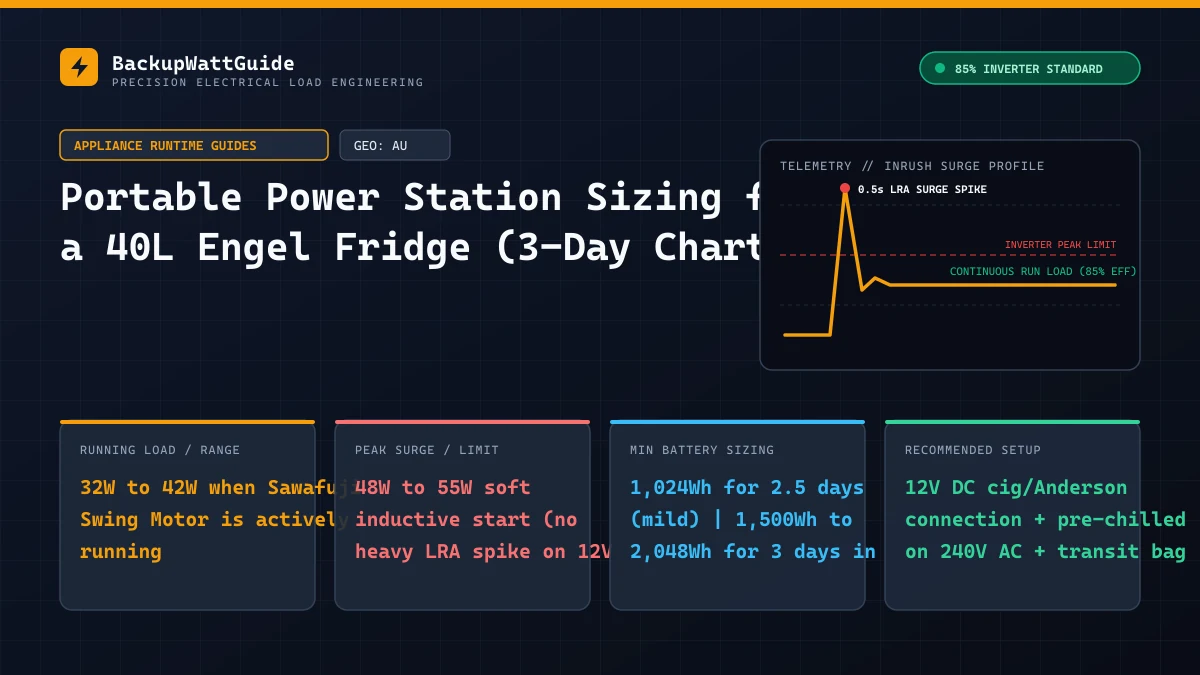
Sizing a portable power station to run a 40-litre Engel MT45 (MT45F-S / MT45F-G4) portable fridge-freezer for a 3-day (72-hour) off-grid camping trip comes down to one number that manufacturer brochures leave out: ambient temperature duty cycle.
On its spec plate, the legendary Japanese Sawafuji Swing Motor inside a 40L Engel draws just 2.5 to 2.75 Amps at 12V DC (roughly 32W to 38W) while the compressor is humming. If a camper assumes the compressor only runs 20% of the time, they buy a small 512Wh battery box, head out into 35°C (95°F) bush heat, and wake up on Day 2 to warm meat and spoiled milk. When canopy and tent temperatures climb past 32°C, that 38W compressor runs 35 to 40 minutes out of every hour—burning over 500 Watt-hours (40 Amp-hours at 12V) every single day.
Here is the exact Watt-hour and Amp-hour math to size a LiFePO4 portable power station for a 40L Engel across mild, warm, and extreme Outback temperatures, along with the 12V vs. 240V wiring rules that add an extra 24 hours of runtime for free.
How the Sawafuji Swing Motor draws power compared to rotary compressors
Unlike Danfoss/Secop rotary compressors found in Dometic, Bushman, or Brass Monkey fridges—which use a spinning crank and piston that can pull a 7A to 9A startup spike for half a second—the Sawafuji Swing Motor inside an Engel is an electro-dynamic reciprocating piston with only one moving part.
Instead of jerking into full stroke instantly, the electro-magnet ramps the piston stroke length up gradually over the first two seconds. According to the Engel Australia MT45F-G4 official specification sheet, that soft-start mechanical design creates two electrical advantages when running off a portable power station:
- Zero High-Amperage Startup Surge: While running on 12V DC, current draw starts gently around 3.2A and settles at 2.5A to 2.8A (33W to 38W). It will never trip the 10-Amp overcurrent protection relay on a portable power station’s 12V cigarette socket during startup (whereas rotary fridges frequently throw a 12V DC port overload error—see our guide on how to fix error code E01, E02, and E03 on portable power stations).
- Extreme Tilt Tolerance: The compressor runs continuously on 30-degree 4WD corrugations without oil starvation.
3-day (72-hour) Watt-hour & Amp-hour consumption chart for a 40L Engel
Because portable power stations are marketed in Watt-hours (Wh) while traditional 4WD dual-battery systems are rated in Amp-hours (Ah at 12.8V), the table below lists both metrics side by side.
All figures assume the fridge cabinet is already pre-chilled to 3°C (37°F) before leaving home, fitted with an Engel insulated transit bag, and plugged directly into the power station’s 12V DC port (incorporating a 90% DC-to-DC regulator efficiency factor and 1.5W continuous DC board standby draw):
| Ambient Daytime Temp | Internal Target Setting | Average Compressor Duty Cycle (%) | Average Hourly Draw (Wh/hr) | 24-Hour Daily Consumption (Wh / Ah) | 3-Day (72-Hour) Total Energy Required | Minimum Power Station Size Required (No Solar) |
|---|---|---|---|---|---|---|
| 20°C (68°F) (Mild Coastal / Winter) | 3°C (Fridge) | 20% – 25% (12–15 mins/hr) | 10.0 Wh/hr | 240 Wh / day (~18.7 Ah @ 12.8V) | 720 Wh (~56 Ah) | 768Wh – 1,024Wh Station |
| 28°C (82°F) (Warm Summer Camp) | 3°C (Fridge) | 35% – 40% (21–24 mins/hr) | 15.5 Wh/hr | 372 Wh / day (~29.0 Ah @ 12.8V) | 1,116 Wh (~87 Ah) | 1,200Wh – 1,500Wh Station |
| 35°C (95°F) (Hot Bush / Enclosed Canopy) | 2°C (Cold Drinks) | 55% – 60% (33–36 mins/hr) | 23.0 Wh/hr | 552 Wh / day (~43.1 Ah @ 12.8V) | 1,656 Wh (~129 Ah) | 2,048Wh Station (or 1,024Wh + 200W Solar) |
| 32°C (90°F) (Freezer Mode) | -16°C (Deep Freeze) | 75% – 85% (45–51 mins/hr) | 31.5 Wh/hr | 756 Wh / day (~59.0 Ah @ 12.8V) | 2,268 Wh (~177 Ah) | 2,048Wh + Extra Battery (or Daily Solar/Alternator) |
Notice what happens when you switch an Engel MT45 from 3°C Fridge Mode to -16°C Freezer Mode in warm weather: the compressor barely cycles off at all, jumping from 372 Wh/day to 756 Wh/day. If you want to run a 40L Engel as a dedicated meat freezer for 3 days without plugging in solar panels or starting your 4WD, you need at least a 2,048Wh to 2,560Wh power station.
Interactive runtime calculator for your exact Engel setup
To calculate your continuous off-grid hours in our calculator below:
- Enter your power station’s rated Battery Capacity (Wh) (e.g.,
1024for a Bluetti AC180, EcoFlow DELTA 2, or iTechworld 1000). - In the Appliance Running Watts (W) box, enter the Average Cycled Watts from the table above (
10for mild 20°C weather,15.5for warm 28°C weather, or23for 35°C Outback heat). - If you plug into the 12V DC socket, change
Inverter Idle Draw (W)to2. If you leave the fridge plugged into the 240V AC socket, leaveInverter Idle Draw (W)at18to see how fast the AC inverter kills your battery!
Real-World Battery Runtime Calculator (85% Inverter Efficiency)
Why you must switch from 240V AC to 12V DC at camp (the 430Wh/day mistake)
Every Engel Combi and MT45 series fridge ships with two separate power cords in the box: a 3-prong 240V AC mains lead (or 120V AC in North America) and a 12V/24V DC vehicle lead. Better yet, Engel builds an automatic priority switch into the fridge’s rear power module: if both the 12V DC cord and 240V AC cord are plugged in at the same time, the fridge automatically runs off 240V mains and switches instantaneously to 12V DC the second mains power is unplugged.
Because the 240V AC cord is convenient, many campers plug the 240V lead straight into the AC outlet on their portable power station. Look at the math of why that costs you nearly half your battery capacity:
- In 28°C weather, your Engel compressor only pulls power for 22 minutes per hour (consuming 14 Wh of actual cooling work per hour).
- During the other 38 minutes of every hour, the fridge thermostat clicks off and draws
0W. - However, because your Engel relies on an automatic thermostat, you have to leave the power station’s 240V AC inverter button switched ON for 24 hours a day.
- Keeping a 1,500W or 2,000W pure sine wave AC inverter energized burns 18W per hour in parasitic idle heat. Over 24 hours, of wasted battery capacity every single day!
On a 1,024Wh power station, running your Engel on the 240V AC socket drains the battery dead in 28 hours (1.1 days). Unplugging the 240V cord, turning the AC inverter button OFF, and plugging the Engel into the 12V DC port stretches that exact same 1,024Wh battery to 62 hours (2.6 days) under identical temperatures.
Fixing the notorious “12V Cigarette Plug Dropout” on portable power stations
If you have ever plugged a 12V fridge into a portable power station’s round cigarette lighter socket, hit a bump on a dirt track (or simply waited until the battery dropped to 50%), and found the Engel turned off or flashing a low-voltage light, you ran into one of two 12V hardware bottlenecks:
1. Regulated 13.6V vs. Unregulated 12V Ports
Older lithium power stations wired their 12V cigarette socket directly to an internal 3-series (3S) NMC battery pack without a DC-to-DC voltage regulator. As the battery drained from 100% down to 20%, the voltage at the 12V socket dropped from 12.6V down to 9.8V. Once accounting for 0.8V of resistance loss down the 2-metre fridge cord, voltage at the back of the fridge dipped below 10.5V, tripping the fridge’s internal battery-protection cutoff while the power station still had 35% charge left!
Modern LiFePO4 power stations (EcoFlow DELTA 2 / DELTA 2 Max, Bluetti AC180 / AC200L, Anker SOLIX C1000, and iTechworld PS series) use a regulated DC-to-DC converter on their 12V ports, locking the output at a rock-steady 12.6V or 13.6V all the way from 100% down to 0% state of charge. (If your station shuts off early at 20% even on a regulated port, your BMS coulomb counter has drifted—follow our steps on how to stop a portable power station stopping at 99% charge to recalibrate the 0% floor).
2. Ditch the spring-tip cigarette plug for an Anderson or Engel Posi-Fit connection
Standard 12V cigarette lighter sockets were designed in the 1920s to heat a glowing coil of wire for ten seconds—not to carry continuous current to a fridge for 72 hours. The tiny spring-loaded center tip makes less than 2 square millimetres of contact, heats up under continuous draw, and backs itself out by 3 millimetres over vehicle vibrations.
Check how Engel designed their 12V cord to solve this, and how to connect it cleanly to your power station:
- The Unscrewable Green Posi-Fit Tip: Look closely at the end of an official Engel 12V cigarette plug. The green plastic collar and metal cigarette tip actually unscrew counter-clockwise, revealing a compact two-blade Hella / Merit / Engel Posi-Fit plug underneath!
- The Anderson SB50 Upgrade (Best for Aussie 4WD Setups): If your power station sits in a canopy or tray setup, cut off the cigarette plug (or make a 15cm adapter pigtail) and crimp a 50A gray Anderson SB50 plug onto the fridge lead. If your power station (like an EcoFlow River/DELTA or Bluetti) does not have a built-in Anderson output port on its faceplate, you can also charge the power station itself from your vehicle’s dual-battery Anderson wiring or solar panels using our pinout guide on how to wire an Anderson plug to XT60 for charging Bluetti and EcoFlow.
4 field habits that cut Engel 40L battery draw by 35%
Before spending an extra $700 AUD on a larger expansion battery, apply these four thermal rules that seasoned Australian tourers use to slash daily Amp-hour draw:
- Pre-Chill the Cabinet and Contents on 240V Mains 24 Hours Before Departure: Cooling 30 cans of warm beer and 4 kilograms of room-temperature meat down from 25°C to 3°C takes roughly 320 Wh to 400 Wh of continuous compressor work. If you load warm food and drinks into an unchilled Engel at the campsite on battery power, you burn an entire day’s worth of lithium capacity in the first six hours just pulling the thermal mass down to temperature. Plug the Engel into 240V household mains the day before your trip, set the dial to
2or3, and load pre-chilled food from your kitchen fridge right before driving off. - Keep the Insulated Transit Bag On 24/7: An Engel MT45 has a painted steel outer cabinet. If sunlight hits that bare steel casing inside a vehicle canopy or awning, surface temperatures exceed 50°C (122°F). Fitting the silver Engel Insulated Transit Bag adds an extra layer of closed-cell thermal foam around the walls and lid zip, cutting compressor run time by 15% to 20% in 35°C weather.
- Never Pack Plastic Bags Over the Internal Evaporator Walls: Unlike domestic fridges with a fan, the 40L Engel cools via conduction plates built into all four inner walls of the aluminum basket liner. Leave a 10mm air gap around the basket mesh so cold air can convect down to the bottom of the tub, and pack full water bottles or frozen cryovac meat flat against the bottom to act as a thermal flywheel overnight.
- Add a Single 160W–200W Portable Solar Blanket for Infinite Runtime: In Australian summer sun, a single 200W folding solar blanket (yielding 130W to 150W of real-world input) puts 550Wh to 700Wh back into a 1,024Wh power station in just 4 hours of midday sun—completely replacing the 552Wh your 40L Engel burns over a 24-hour 35°C day. (If you also use your portable solar panels at home between camping trips, see our guide on how to secure portable solar panels on an apartment balcony railing).
# Frequently Asked Questions
Should I plug my 40L Engel fridge into the 240V AC outlet or the 12V DC socket on my portable power station?
Always use the 12V DC socket when running off battery power. Although an Engel MT45 switches automatically between 240V AC and 12V DC, turning on the 240V AC inverter inside your power station burns an extra 15W to 22W every single hour just keeping the inverter awake—even during the 40 minutes per hour when the fridge thermostat has cycled off. Using the 12V DC port doubles your off-grid runtime.
Why does my Engel fridge show an error or cut out on a 12V cigarette socket when the power station still has 40% battery left?
Standard cigarette lighter plugs have weak spring-loaded tips and thin 18 AWG wire with up to 1.2 Volts of voltage drop under a 3A load. Worse, older unregulated power stations drop their 12V port voltage from 13.2V down to 10.8V as the battery drains. If voltage at the back of the fridge dips below 10.5V during compressor startup, the Engel low-voltage cutoff shuts the compressor down. Always buy a power station with a regulated 12.6V/13.6V DC output and hardwire an Anderson or Posi-Fit plug.
How many watt-hours does a 40L Engel MT45 actually use in 24 hours?
In mild 22C (72F) coastal weather with the cabinet set to 3C (fridge mode), a 40L Engel runs at roughly a 25% duty cycle and consumes about 240Wh to 260Wh per 24 hours. In 35C (95F) Australian summer heat inside a canopy or tent, the compressor duty cycle climbs to 50%–60%, consuming 480Wh to 580Wh per 24 hours.
Lead Technical Electrical Editor
Peer-ReviewedPower Systems Analyst & Backup Power Specialist
All technical guides and electrical sizing benchmarks are calculated using standard Nameplate Full Load Amps (FLA), Locked Rotor Amps (LRA) surge models, and an empirically verified 85% Inverter Power Factor & Conversion Efficiency model.