How to Charge a Caravan Power Station from a Ute Alternator Driving
Quick Specification & Sizing Overview
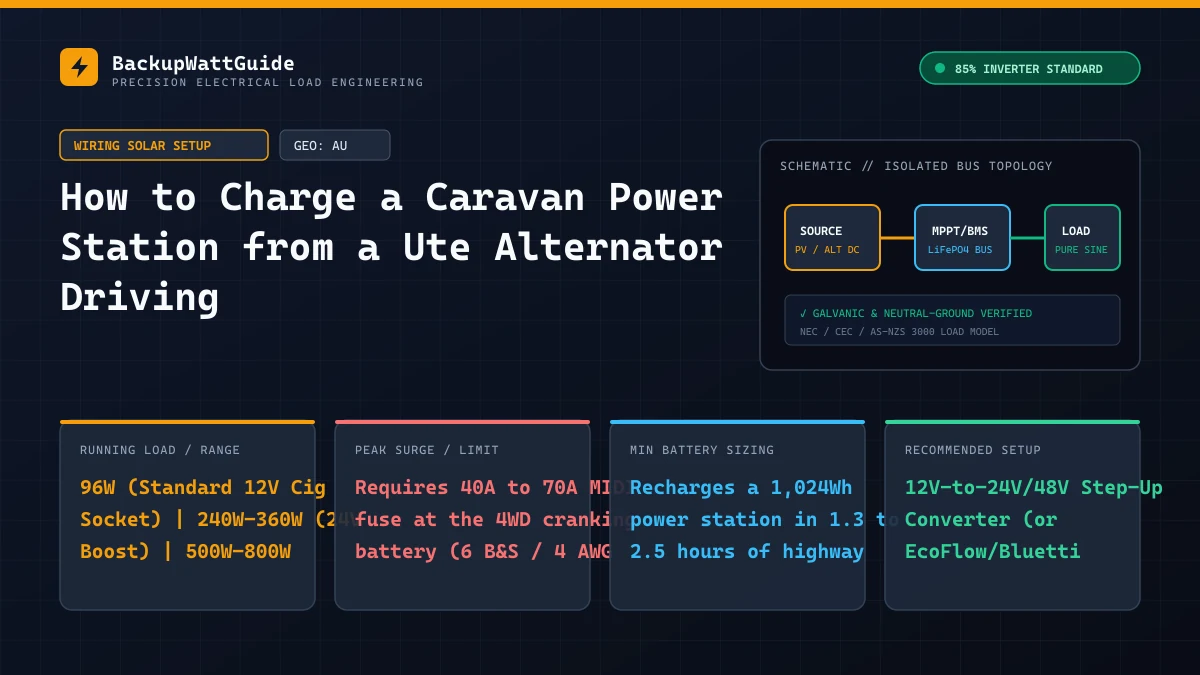
When three days of coastal rain wipe out your solar input and your 40L Engel fridge has pulled your 1,024Wh or 2,048Wh portable power station down to 15%, starting your 4WD and going for a 90-minute drive to town should fill your battery back to 100%.
Instead, most tourers plug the factory car-charging cord into their Ute’s dashboard cigarette lighter socket, drive for two hours, and look back to see the power station only climbed from 15% to 31%.
Here is why standard 12V vehicle charging is painfully slow on portable power stations, why raising voltage (not amps) is the secret to unlocking your power station’s fast MPPT charger on the road, and how to compare the 4 real-world ways to charge a power station from your Ute or 4WD alternator at 200W, 360W, or 800W.
Why 12V cigarette sockets and 12V-to-12V DC-DC chargers hit a brick wall
Every portable power station (EcoFlow DELTA/River, Bluetti AC180/EB70S, Anker SOLIX, Jackery) routes both its Solar Input and its Car Charging Input through the exact same internal MPPT controller port (typically an XT60i, MC4/Aviation, or DC7909 port).
Look at how that internal MPPT controller limits incoming power using the basic electrical equation Watts = Volts × Amps:
- The MPPT controller has a strict hardware current ceiling—usually 8 Amps in Car Mode, or 10A to 15 Amps maximum in Solar Mode.
- However, it has a huge voltage ceiling—usually 60 Volts (or up to 150V on larger units).
Because the current is locked at 8A to 15A, feeding 12 Volts into the port physically cannot deliver fast charging—even if you spend $500 on a 40-Amp 12V-to-12V Redarc BCDC charger! The power station simply ignores the extra amps and caps intake at 8A to 15A (13.5V × 8A = 108 Watts).
To multiply your alternator charging speed by 3x to 7x without tripping the power station’s 15-Amp current limit, you must step the 12V alternator voltage up to 24V, 36V, or 48V before it enters the power station’s solar port!
Comparing all 4 Ute alternator charging methods (96W vs. 800W)
Compare the charging wattage, time to recharge a 1,024Wh power station, and wiring cost across all four vehicle charging setups below:
| Alternator Charging Method | Voltage & Current Fed Into Power Station | Real-World Charging Speed (Watts) | Driving Time to Charge a 1,024Wh Pack (0–100%) | Approximate Hardware Cost (AUD / USD) |
|---|---|---|---|---|
| Method 1: Factory 12V Cigarette Lighter Socket | 12.6V – 13.8V @ 8.0 Amps | 96W – 108W | 10.5 to 11.5 Hours | $0 (Included in box) |
| Method 2: 50A Anderson to XT60i Cable (15A Solar Sense Pin Grounded) | 12.8V – 13.8V @ 15.0 Amps | 190W – 205W | 5.2 to 5.8 Hours | 40 (Requires ignition relay!) |
| Method 3: 12V-to-24V Step-Up DC-DC Converter (e.g., Victron Orion-Tr 12/24-15A) | 24.0V – 28.0V @ 15.0 Amps | 360W – 400W | 2.6 to 2.9 Hours | 190 (Universal across all brands) |
| Method 4: Dedicated 48V Alternator Charger (EcoFlow 800W / Bluetti Charger 1 / Pecron 500W) | 40.0V – 54.0V @ 11A – 16A | 500W – 800W | 1.3 to 2.1 Hours! | 499 |
Use the calculator below to see how many hours of driving it takes to replace your daily camp power draw at each wattage tier:
Real-World Battery Runtime Calculator (85% Inverter Efficiency)
Method 2: The $30 Anderson-to-XT60i Upgrade (Doubles Speed to ~200W)
If your Ute or 4WD already has a 50A gray Anderson plug wired in the tub or canopy (protected by a Voltage Sensitive Relay or Ignition Relay so it cuts off when the engine is turned off), you can double your charging speed from 96W to ~200W for $30 without buying any converter boxes:
- Instead of using the factory cigarette lighter plug (which leaves the XT60i sense pin open and locks EcoFlow/Anker into 8A Car Mode), plug an Anderson-to-XT60i cable (with the center sense pin bridged to Negative) between your canopy Anderson socket and the power station’s solar port.
- Follow the exact pinout and wire-gauge chart in our guide on how to wire an Anderson plug to XT60 for charging Bluetti and EcoFlow.
- Because the grounded sense pin tricks the power station into 15A Solar MPPT Mode, it pulls up to 15 Amps at 13.5V (~200W) whenever your engine is running!
- Mandatory Safety Check: Never plug a sense-pin-grounded XT60i cable into an unswitched Anderson socket wired straight to your starter battery without a VSR or ignition relay in between—or the power station will keep pulling 200W after you park and flatten your cranking battery!
Method 3: The Universal 12V-to-24V Step-Up Converter (~360W to 400W)
This is the favourite DIY setup for Australian and North American tourers who own a Bluetti AC180, Jackery, or Anker SOLIX C1000 and want 360W to 400W of driving charge for under 180 dollars:
How the 12V-to-24V Step-Up Method Works
- Mount an isolated or non-isolated Victron Orion-Tr 12/24-15A (360W) DC-DC Converter (or a heavy-duty waterproof 12V-to-24V 20A step-up boost converter with an ignition trigger wire) inside your Ute canopy or behind the rear seat.
- Feed the 12V Input of the converter from your vehicle starter battery (via 6 B&S / 13.5mm² / 6 AWG cable fused with a 50A MIDI fuse within 30cm of the positive battery terminal).
- On a Victron Orion-Tr, wire the Remote (
L/H) terminal to an ignition-switched fuse tap (or use its built-in engine-running voltage detection) so the converter only turns on when the alternator is spinning above 13.3V. - Connect the 24V Output of the converter to an XT60i cable (or MC4/DC7909 plug for Bluetti) plugged into your power station’s solar input port.
- The Result: Your power station sees a steady 24V to 28V DC source (identical to a 24V solar panel!). Even if your power station caps current at 15 Amps, 26V × 15A = 390 Watts of clean charging—replenishing a 1,024Wh battery from empty to full during a 2.5-hour drive between campsites!
(Important note: Never plug both solar panels and a 24V alternator converter into the exact same MPPT port at the same time with a Y-adapter! Either use a changeover switch, unplug the alternator lead when setting up camp solar, or use Method 4 below).
Method 4: Dedicated 500W–800W Smart Alternator Chargers (Bluetti Charger 1 & EcoFlow 800W)
Both EcoFlow and Bluetti now build dedicated high-voltage alternator boost chargers specifically for portable power stations:
- Bluetti Charger 1 (560W Universal DC-DC Charger): Works with 95% of all portable power station brands (Bluetti, EcoFlow, Anker, Jackery) because it outputs programmable 15V to 56V DC at up to 560W via a standard MC4/XT60 solar cable! It includes built-in smart-alternator D+ sensing and automatic voltage cutoff so it never drains your 4WD starter battery.
- EcoFlow 800W Alternator Charger: Connects straight into the proprietary Extra Battery Port on EcoFlow DELTA 2, DELTA 2 Max, and DELTA Pro units (or via an XT60 adapter for River/third-party units), pumping up to 800 Watts while driving—and even works in reverse to jump-start or trickle-charge your 4WD’s 12V starter battery from your EcoFlow if you leave your headlights on at camp!
Cable gauge & fusing table for 360W to 800W Ute installations
Pulling 500W to 800W from a 12V alternator means the input side of the converter is drawing 45 Amps to 75 Amps at 12.8V all the way from your engine bay back to your Ute tub (a 5-metre to 6-metre cable run). Never wire a 500W+ alternator charger into existing thin canopy accessory wiring! Use this cable sizing chart:
| Charger Wattage Tier | Max 12V Current Drawn from Alternator | Minimum Wire Gauge (5m–6m Engine-to-Tub Run) | Recommended Fuse at Starter Battery |
|---|---|---|---|
| 200W (Anderson Direct) | ~16 Amps | 8 B&S / 8 AWG (8–10 mm²) | 25A – 30A MIDI / Blade Fuse |
| 360W – 400W (12V-to-24V Converter) | ~32 – 38 Amps | 6 B&S / 6 AWG (13.5 mm²) | 50A MIDI Fuse |
| 560W (Bluetti Charger 1) | ~50 Amps | 6 B&S / 6 AWG (13.5–16 mm²) | 60A MIDI / Thermal Breaker |
| 800W (EcoFlow Alternator Charger) | ~70 – 75 Amps | 4 B&S / 4 AWG (21–25 mm²) | 100A – 125A MEGA / ANL Fuse |
For official Dual-Battery and smart alternator voltage thresholds on modern Euro-5/Euro-6 variable voltage vehicles, see the Redarc Electronics technical bulletin on Variable Voltage Smart Alternators.
Once your power station is mounted in the back of the Ute, protect it from dust and rain on corrugated tracks using our Bunnings heavy-duty weatherproof storage tub build, and remember to run a full slow AC charge at home every few months to prevent 99% BMS coulomb counter drift.
# Frequently Asked Questions
Why does plugging my power station into my Ute's 12V cigarette lighter socket take 11 hours to charge a 1,000Wh battery?
Vehicle cigarette lighter sockets are capped at 8 Amps to 10 Amps by factory wiring and the power station's internal car-mode limit. At 12.6V to 13.5V, 8 Amps only delivers 96W to 108W of charging power. If your 40L camping fridge is simultaneously pulling 25W from the power station while you drive, net charging drops to just 75W—meaning an hour of driving only adds 7% back to a 1,024Wh battery.
Can I use a standard 12V Redarc BCDC1225D or Victron Orion 12/12 DC-DC charger to fast-charge a portable power station?
A standard 12V-to-12V DC-DC charger outputs 14.2V to 14.6V, which still hits the exact same 8-Amp to 15-Amp current bottleneck inside your power station's solar MPPT input port (capping your charge speed at ~115W to 210W even on a 40A Redarc!). To get 350W to 800W into a portable power station's solar port, you have to boost the VOLTAGE (using a 12V-to-24V or 12V-to-48V converter or Victron Orion 12/24) rather than just boosting amperage at 12V.
Will a 500W or 800W alternator charger burn out the smart alternator on my Ford Ranger, Hilux, or D-Max?
Modern Euro-5 and Euro-6 turbo-diesel Utes (Ranger, Hilux, D-Max, BT-50, Amarok) typically carry 150-Amp to 250-Amp variable-voltage smart alternators. Pulling 40A to 65A (500W to 800W) while driving at highway speeds sits well within the alternator's continuous output margin, provided you use an ignition-triggered charger that reduces draw or cuts off at low idle.
Lead Technical Electrical Editor
Peer-ReviewedPower Systems Analyst & Backup Power Specialist
All technical guides and electrical sizing benchmarks are calculated using standard Nameplate Full Load Amps (FLA), Locked Rotor Amps (LRA) surge models, and an empirically verified 85% Inverter Power Factor & Conversion Efficiency model.