Can a Portable Power Station Run a Car Block Heater at -25C?
Quick Specification & Sizing Overview
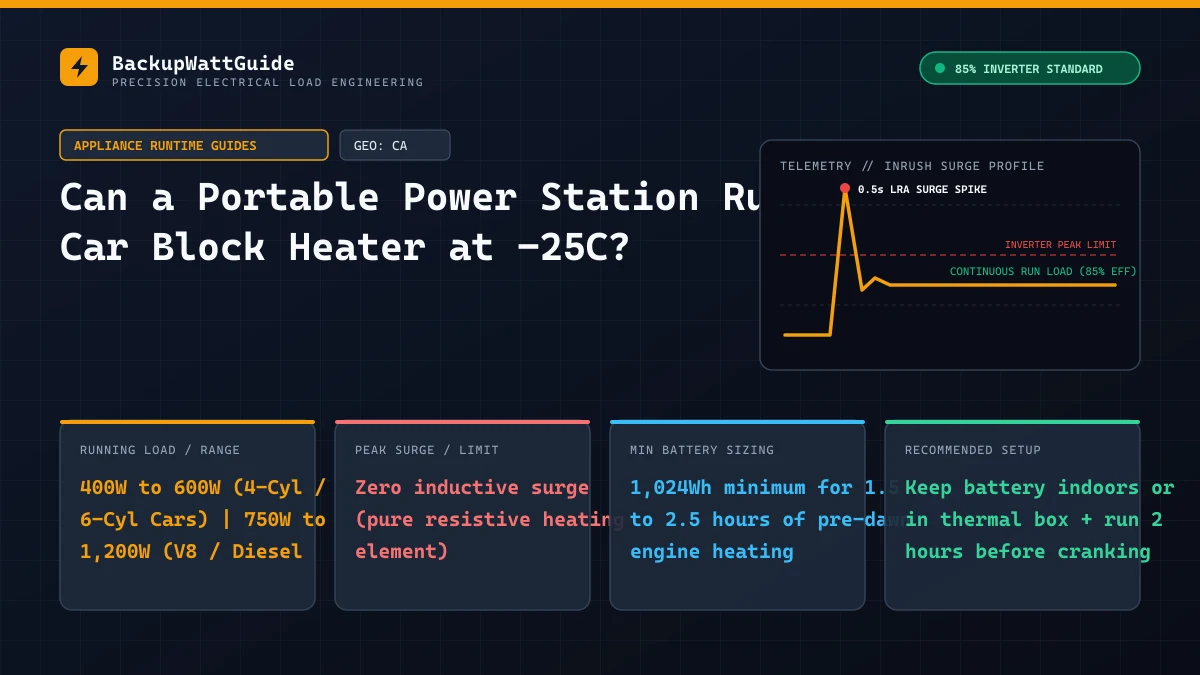
When temperatures plunge to -25°C to -35°C (-13°F to -31°F) across the Canadian prairies, northern Ontario, Alaska, or the upper Midwest—and you are parked in an apartment lot without energized winter plug-in posts, at a backcountry trailhead, or at an off-grid hunting cabin—an unheated engine turns 5W-30 motor oil into thick molasses while your 12V lead-acid starter battery loses 60% of its cold-cranking amps.
Plugging your vehicle’s 120V engine block heater into a portable power station is the cleanest way to guarantee a morning start without idling the engine all night. However, if you plug a truck into a 1,000Wh battery at 10:00 PM expecting it to run until 7:00 AM, the battery will be stone dead by midnight. To warm an engine reliably on battery power, you need to know your engine’s exact block heater wattage, understand the 2-hour thermal equilibrium rule, and keep the extreme cold from triggering your power station’s -20°C low-temperature shutdown.
Engine block heater wattage chart by vehicle and engine size
An engine block heater (whether a frost-plug immersion heater screwed into the coolant jacket, a cartridge heater slid into an aluminum engine block, or a lower radiator hose heater) is a 100% resistive heating coil. Like an electric kettle, it has zero startup surge wattage—if it draws 450 running watts, its peak surge is also 450 watts.
Check the typical 120V wattage draw of factory OEM and aftermarket block heaters across North American vehicles below:
| Vehicle & Engine Category | Typical Block Heater Wattage (120V) | Plus 12V Battery Blanket / Oil Pan Pad (If Installed) | Energy Required for a 2-Hour Pre-Start Warmup | Minimum Power Station Size Required (At -20°C Derating) |
|---|---|---|---|---|
| Compact & Midsize 4-Cyl / Hybrid (Toyota RAV4, Corolla, Honda CR-V, Subaru Outback) | 350W – 400W | +80W (Optional) | 700 – 800 Wh (~920 Wh from battery) | 1,024Wh Station (Kept warm above 10°C) |
| V6 SUVs & Half-Ton Gas Trucks (Ford F-150 3.5 EcoBoost/5.0, RAM 1500, Tacoma, GM 5.3L) | 400W – 600W | +100W (Optional) | 800 – 1,200 Wh (~1,050–1,400 Wh from battery) | 1,200Wh to 1,500Wh Station |
| Heavy-Duty Gas V8 Trucks (Ford 6.8L/7.3L Godzilla, Chevy 6.6L Gas, RAM 6.4L Hemi) | 600W – 750W | +125W (Optional) | 1,200 – 1,500 Wh (~1,400–1,750 Wh from battery) | 1,500Wh to 2,048Wh Station |
| Heavy-Duty Diesel Trucks (6.6L / 6.7L) (Ford PowerStroke, Duramax, Cummins 6.7L) | 750W – 1,000W+ | +150W (Common in North) | 1,800 – 2,500 Wh (Requires 2.5–3 hrs for heavy cast iron) | 2,048Wh to 3,000Wh+ Station |
Why you only need 90 to 120 minutes of heating (The 2-Hour Rule)
The biggest mistake drivers make with a portable power station is plugging the block heater in when they park at 9:00 PM.
- A 500W block heater running for 9 hours overnight consumes —enough to drain four EcoFlow DELTA 2 or Bluetti AC180 units completely flat!
- Better yet, thermal testing published by Natural Resources Canada (NRCan) demonstrates that almost all of the useful coolant temperature rise from a block heater happens in the first 90 to 120 minutes.
Why? Because during the first two hours, the 400W–600W heating element warms the antifreeze surrounding the cylinders from -25°C up to roughly +10°C to +25°C. Once the aluminum or cast-iron engine block reaches 40°C warmer than the surrounding -25°C arctic air, heat radiates outward through the hood and radiator grill at the exact same speed the block heater puts it in. Running the heater for hours 3 through 9 adds almost zero extra warmth to the cylinders.
How to trigger the block heater from bed 2 hours before leaving
Instead of walking out into a -30°C windchill at 5:00 AM to press the AC button on your power station, use one of two timer methods:
- Use the Built-In “Scheduled Tasks” Timer in the Power Station App: EcoFlow, Bluetti, and Anker SOLIX companion apps include a Scheduled Tasks / Timer menu stored directly on the power station’s onboard clock (no Wi-Fi required once saved). Set a schedule to Turn AC Output ON at 5:00 AM when you plan to crank the engine at 7:00 AM.
- Use a Mechanical 24-Hour Outdoor Timer Plug (Plus an 8W Dummy Load if Needed): If your power station lacks a scheduled-on timer in its app, you can leave the AC inverter switched on overnight with a heavy-duty outdoor timer plug set for 5:00 AM. (Note: Remember that leaving the AC inverter sitting idle for 7 hours before 5:00 AM burns of battery capacity, and you must turn ECO / AC Auto-Shutoff OFF so the inverter doesn’t go to sleep at midnight!)
Use our calculator below to check the exact minutes of block heater runtime your battery delivers. Remember to account for winter capacity derating if the battery itself is below room temperature:
Real-World Battery Runtime Calculator (85% Inverter Efficiency)
The -20°C LiFePO4 trap: Why you cannot leave the power station on the snow
If you carry your portable power station out to your truck at 10:00 PM, set it on the snowbank or concrete parking stall in -25°C (-13°F) weather, and set a timer for 5:00 AM, your block heater will not turn on at 5:00 AM.
As detailed in our troubleshooting guide on why your LiFePO4 power station won’t charge in freezing weather, lithium iron phosphate cells have two strict cold-weather boundaries:
- Charging is locked out at 0°C (32°F).
- Discharging (running the AC outlets) is locked out at -20°C (-4°F).
Worse, even if the cells only cool down to -15°C (5°F) inside the truck cab overnight, the liquid electrolyte inside the cells thickens so much that usable Watt-hour capacity temporarily shrinks by 25% to 35%, and applying a heavy 600W block-heater load causes instantaneous voltage sag across the cold cells—tripping a low-voltage overload shutdown after just 15 minutes!
3 ways to keep your power station warm while running a block heater
- Method A (Walk-Out Pre-Warm at 5:30 AM — Best Capacity): Store the portable power station indoors inside your 20°C (68°F) apartment, cabin, or hotel room overnight. At 5:30 AM (90 minutes before departure), set the warm power station inside the passenger footwell of your vehicle, pass the block heater cord through the rubber door weatherstripping at the lower front hinge corner (where the thick rubber seal compresses without pinching a 14 AWG wire), close and lock the vehicle doors, and let the 20°C battery discharge for 90 minutes. Because the battery starts at 20°C and generates 30W of internal waste heat while running a 500W load, the cells will stay above +10°C for the entire 90-minute run even inside a -25°C cab!
- Method B (Overnight Cab Storage in an Insulated Thermal Box): If you are sleeping in a winter tent or trailhead lot and must leave the battery inside the vehicle overnight, place the power station inside a 5-sided 2-inch XPS foam insulated box (see our build guide on how to build an insulated thermal box for ice fishing power stations) along with a 12V 20W silicone warming pad or two 60°C hot water bottles so the internal cell temperature stays above +5°C until your 5:00 AM timer fires.
- Method C (Balcony / Window Extension Cord): If your apartment parking stall sits directly below your ground-floor or second-floor balcony, keep the power station warm inside your living room and pass a 12 AWG cold-weather SJEOOW blue extension cord (rated down to -50°C so the rubber jacket doesn’t crack like cheap orange vinyl cords) out through a flat window pass-through or balcony setup.
Troubleshooting: Why your block heater shows 0W on the power station screen
You plug your vehicle’s block heater cord into your portable power station, turn on the 120V AC inverter, and the LCD screen reads 0W. Before assuming your power station is defective, check these two hidden parts on modern North American vehicles:
1. The -18°C (0°F) Inline Thermostatic Cord Switch
To stop drivers from wasting electricity in mild autumn weather, Ford, GM, Stellantis (RAM/Jeep), and Toyota frequently install a thermostatic switch inside the molded 3-prong head of the factory block heater cord (look for a bulky cylindrical bulge 2 inches behind the brass prongs).
- Inside that bulge sits a bimetallic disc that stays physically open (disconnected) whenever air temperature is warmer than -18°C (0°F)!
- If you try testing your block heater setup in your garage at -5°C (23°F), the thermostat switch inside the cord refuses to close, and your power station will show
0W. - How to test it above -18°C: Hold an ice pack wrapped around a bag of salted freezer ice (or spray an inverted can of compressed electronics duster for 3 seconds) onto the round bulge behind the 3-prong plug to chill the sensor below -18°C; you will hear a tiny click and see your power station jump up to 400W–600W immediately.
2. Burnt Heater Element or Corroded Bumper Plug (Ohm Meter Check)
Road salt and slush sprayed onto the front bumper corrode the brass prongs of block heater cords within three winters. If the temperature is -25°C and your power station still reads 0W (or immediately trips a GFCI or overload fault), set a digital multimeter to Ohms () and touch the probes across the two flat brass blades of your vehicle’s block heater plug:
- Healthy 400W Block Heater: Reads roughly 34 to 38 Ohms ().
- Healthy 600W Block Heater: Reads roughly 22 to 26 Ohms.
- Healthy 1,000W Diesel Block Heater: Reads roughly 13 to 15 Ohms.
- Reads
OL(Open Loop / Infinite Resistance): Either the -18°C cord thermostat is still warm/open, the cord wire is broken behind the plug, or the heating coil inside the engine block has burned out.
Once your engine starts up at 7:00 AM, plug your power station’s vehicle charging cable into your truck’s 12V socket (or high-output Ute/truck alternator charger) so the alternator puts those 800 Watt-hours back into the battery while you drive to work or camp.
# Frequently Asked Questions
Do I need to run my car's block heater all night long on a portable power station?
No, and trying to run a 600W block heater for 8 hours overnight would require a massive 5,500Wh battery bank. Research by cold-weather fleet operators shows an engine block reaches thermal equilibrium after 2 to 3 hours of heating; running a block heater for 8 hours simply radiates heat into the driveway wind. Running a 400W to 600W block heater for just 90 to 120 minutes right before you start the vehicle warms the coolant enough for an easy -25C crank and fits inside a single 1,024Wh portable power station.
Why did my power station shut off after 20 minutes when I set it on the snow next to my truck bumper at -25C?
Lithium Iron Phosphate (LiFePO4) batteries have a hard-coded low-temperature discharge cutoff at -20C (-4F). Even before hitting -20C, cold electrolyte at -15C causes severe voltage sag under a 500W to 1,000W load, tripping the low-voltage cutoff when the pack is still 40% full. Always keep the power station inside your warm house, inside the vehicle cab with a pre-warmed thermal box, or inside an insulated cooler bag.
Why won't my factory Toyota or Ford block heater cord draw any watts until it gets below -18C?
Many factory OEM block heater cords sold in Canada and the northern US (especially on newer Toyota, Lexus, Ford, and GM vehicles) have a thermo-switch moulded right into the 3-prong plug head or inline cord that stays open above -18C (0F). If you test your power station on the block heater in a 5C garage in October, the screen will read 0W until the outdoor temperature drops below -18C.
Lead Technical Electrical Editor
Peer-ReviewedPower Systems Analyst & Backup Power Specialist
All technical guides and electrical sizing benchmarks are calculated using standard Nameplate Full Load Amps (FLA), Locked Rotor Amps (LRA) surge models, and an empirically verified 85% Inverter Power Factor & Conversion Efficiency model.