Can You Plug a Portable Power Station into a 30-Amp RV Outlet?
Quick Specification & Sizing Overview
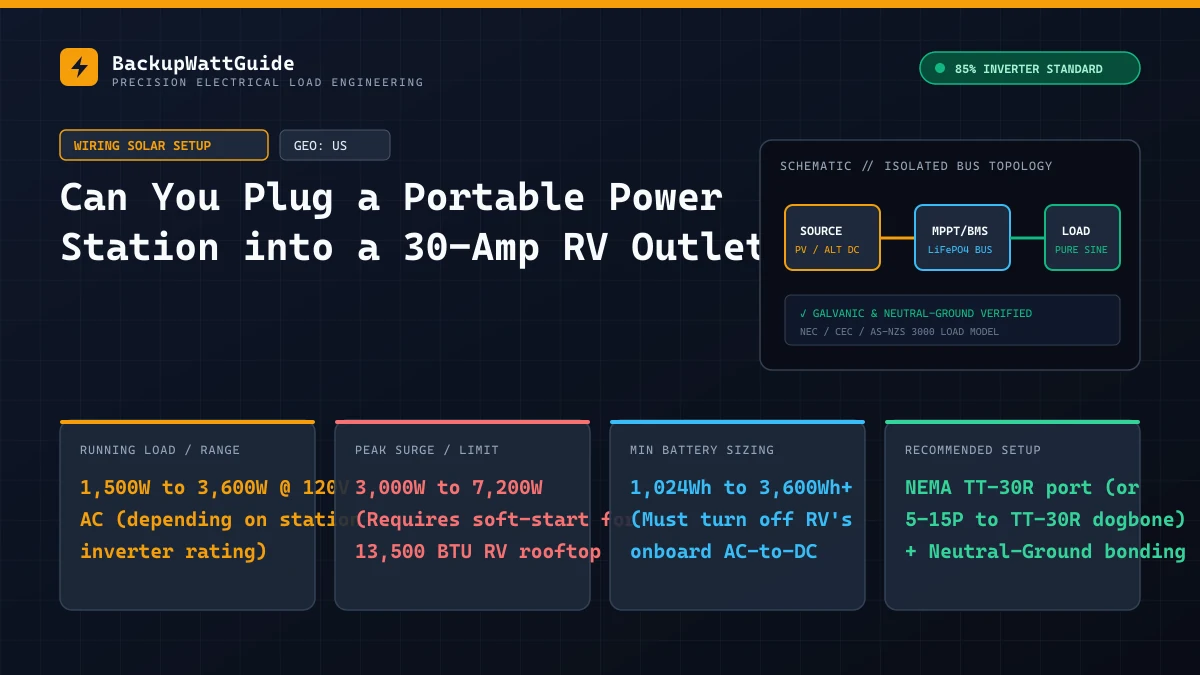
Plugging your travel trailer, fifth wheel, or camper van’s 30-Amp shore power cord directly into a portable power station turns every 120V wall outlet, overhead microwave, and television inside your rig on at once—without firing up a noisy 3,500W gas inverter generator during campground quiet hours.
Because a standard North American 30-Amp RV shore cord (NEMA TT-30P) is a 120-Volt single-phase connection (not 240 Volts!), you can connect it either to a large power station with a built-in 30A TT-30R RV outlet (like an EcoFlow DELTA Pro, Bluetti AC200L/AC300, or Anker SOLIX F2000) or to a compact 1,000W–1,800W power station using a $10 NEMA 5-15P to TT-30R “dogbone” adapter.
However, three classic RV electrical traps catch campers the first time they plug their trailer into a battery box: the 450W Onboard Converter Vampire Loop, the EMS Surge Protector Open-Ground Lockout, and the 3,200W Rooftop Air Conditioner LRA Spike.
Understanding the 30-Amp RV plug (NEMA TT-30) vs. 15A household outlets
Many new RV owners look at the big, heavy 3-prong plug on the end of their trailer’s shore power cord—with its two angled flat blades and round ground pin—and assume it carries 240V like a household clothes dryer plug.
Never confuse a 120V 30A NEMA TT-30 (“Travel Trailer 30A”) plug with a 240V dryer plug!
- A NEMA TT-30 plug carries 120 Volts AC at up to 30 Amps () across one Hot blade, one Neutral blade, and one Equipment Ground pin.
- A standard household outlet on your portable power station (NEMA 5-15R or 5-20R) carries the exact same 120 Volts AC, just capped at 15 Amps (1,800W) or 20 Amps (2,400W).
Because the voltage and frequency (120V / 60Hz) are identical, connecting your 30A RV shore cord to a 15A portable power station via a NEMA 5-15P Male to TT-30R Female Dogbone Adapter is 100% electrically compatible. You are not stepping voltage up or down; you are simply feeding your RV’s 120V breaker box from an 1,800W source instead of a 3,600W pedestal.
Trap #1: The 500W “Battery Charging a Battery” Converter Loop (Flip This Breaker Off!)
Here is why campers plug their trailer into a fully charged 1,024Wh or 2,048Wh portable power station at 6:00 PM, turn on zero 120V appliances, and find the power station completely dead at 9:30 PM:
- Your RV already has a 12V DC house battery mounted on the trailer tongue or in a storage bay that runs your 12V LED ceiling lights, water pump, and propane furnace fan.
- Hidden behind your RV’s interior breaker panel sits a 35-Amp to 55-Amp AC-to-DC Power Converter (such as a WFCO or Progressive Dynamics converter).
- The second your RV senses 120V AC coming through the external shore power cord, that onboard converter automatically turns on and pulls 450W to 750W of 120V power to bulk-charge your trailer’s 12V tongue battery!
- You are now taking 12V/48V DC out of your portable power station, inverting it to 120V AC (losing 15%), and feeding it into your RV’s 80%-efficient converter to turn it right back into 12V DC—wasting 35% of your energy as pure heat while draining your portable power station flat in two hours!
The mandatory 10-second fix before plugging in your shore cord
Walk inside your RV, open the main 120V circuit breaker door, and flip the 15A breaker labeled CONVERTER (or CONV / BATTERY CHARGER) to the OFF position before plugging your shore cord into your portable power station!
- While the
CONVERTERbreaker is flipped off, your RV’s 12V ceiling lights and water pump will continue running natively off your trailer’s 12V tongue battery at zero inverter loss, while your portable power station saves 100% of its Watt-hours for your 120V outlets, coffee maker, or microwave. - Second breaker to flip OFF: Check that your RV Water Heater Electric Element switch (
WATER HEATERbreaker or exterior lower switch on Suburban/Dometic heaters) and your 3-Way Absorption Fridge AC Element are switched to Propane (GAS) mode. An electric RV water heater element draws 1,400W continuously, and an absorption fridge draws 325W continuously—both of which run for weeks on a $20 tank of propane instead of killing your lithium battery in 90 minutes!
Trap #2: Fixing the “Open Ground / E2” error on RV EMS surge protectors
If your RV has a portable or hardwired Electrical Management System (EMS)—such as a Progressive Industries EMS-PT30X or a Hughes Power Watchdog—plugging it into a Bluetti, EcoFlow, Anker, or Jackery power station will cause the surge protector to flash E2 (Open Ground / Open Neutral) or a red fault LED and refuse to let electricity into your camper.
Just like the flame-sensor issue covered in our natural gas furnace blower guide and our home transfer switch guide, an RV EMS checks safety by measuring voltage between Hot-to-Neutral (120V), Hot-to-Ground (120V), and Neutral-to-Ground (0V).
- Because an unplugged portable power station has a floating neutral, its Neutral and Ground buses are not connected internally.
- When the EMS probes the floating socket, it sees ~60V between Hot and Ground and ~60V between Neutral and Ground, assumes the campground pedestal ground rod is severed, and blocks the connection.
The Fix: Plug a $12 Neutral-Ground Bonding Plug into any unused 15A NEMA 5-15R outlet on the front of your portable power station before connecting your RV shore cord and EMS to the 30A TT-30R port (or dogbone). The bonding plug ties Neutral to Ground inside the power station’s AC strip, giving your EMS a clean 0V Neutral-to-Ground reading so it clicks on after its 30-second countdown. (Remember to remove the bonding plug before plugging the power station into a house GFCI outlet later—see why power stations trip GFCI outlets when charging).
Trap #3: Can a portable power station run a 13,500 or 15,000 BTU RV air conditioner?
Running a microwave (1,450W), toaster (1,100W), or television (80W) through your 30A shore cord works on almost any 1,800W+ portable power station. The boss fight is your rooftop RV air conditioner (Dometic Brisk II, Coleman-Mach, or Furrion):
| RV Rooftop A/C Setup | Continuous Running Watts | Compressor Startup Surge (LRA Watts) | Minimum Power Station Required | Runtime on a 2,048Wh Battery (Compressor 65% Duty Cycle) |
|---|---|---|---|---|
| 13,500 BTU A/C (Factory Stock — No Soft-Start) | 1,250W – 1,450W | 3,100W – 3,600W (55–62 LRA) | 2,400W – 3,600W Inverter (4,500W+ Peak Surge) | ~1.9 Hours (Consumes ~900 Wh/hr) |
| 13,500 BTU A/C (With SoftStartRV / Micro-Air EasyStart) | 1,250W – 1,450W | 1,550W – 1,800W (65% Surge Reduction) | 1,800W – 2,000W Inverter (3,000W Peak Surge) | ~1.9 Hours (Needs 4,096Wh+ for 4 hours) |
| 15,000 BTU Ducted A/C (Factory Stock) | 1,500W – 1,750W | 3,600W – 4,200W | 3,000W – 3,600W Inverter (Native TT-30 Port) | ~1.6 Hours (Consumes ~1,100 Wh/hr) |
| 15,000 BTU Ducted A/C (With Capacitive Soft-Start) | 1,500W – 1,750W | 1,850W – 2,150W | 2,000W – 2,400W Inverter | ~1.6 Hours |
| 12V/24V DC Inverter Rooftop A/C (e.g., Furrion Chill Cube / Velit) | 450W – 750W (Eco Variable Mode) | 800W (Zero hard LRA spike) | 1,000W Inverter (or direct 12V/24V DC) | 3.8 to 5.2 Hours on 2,048Wh |
Notice the difference a $280 Capacitive Soft-Start Module (like a Micro-Air EasyStart or SoftStartRV wired inside the rooftop shroud) makes on a standard 13,500 BTU camper air conditioner:
- Without a soft-start, a 13,500 BTU compressor slams the inverter with a 3,400W locked-rotor surge every 10 minutes as the thermostat cycles on and off—instantly tripping a 1,800W or 2,000W power station into an E01 overload error.
- With a soft-start installed, startup inrush drops to 1,650W, allowing an 1,800W–2,000W station (via a 5-15P to TT-30R dogbone) to start and run the air conditioner cleanly to cool down the rig for a midday nap!
- (Warning: Just like running a 1000W power station on a sump pump, never turn on EcoFlow X-Boost or Bluetti Power Lifting to try to start an RV air conditioner! Dropping voltage from 120V to 95V stalls the compressor rotor and burns out the start capacitor).
Use the calculator below to model your RV shore-power loads once the converter breaker is switched off:
Real-World Battery Runtime Calculator (85% Inverter Efficiency)
For official NEMA TT-30 receptacle wiring standards and 30-amp recreational vehicle branch distribution rules, consult NFPA 70 (National Electrical Code) Article 551 for Recreational Vehicles.
# Frequently Asked Questions
Can I plug my 30-amp RV shore power cord into a 15-amp (1,800W) portable power station using a dogbone adapter?
Yes. A NEMA TT-30P (30-amp RV plug) to NEMA 5-15R (15-amp household plug) dogbone adapter connects your RV's entire 120V breaker panel to the standard 3-prong outlet on a 1,000W to 1,800W power station. Both NEMA 5-15 and NEMA TT-30 operate at 120 Volts single-phase; you simply have to keep your total simultaneous RV appliance load below the continuous wattage rating of your power station (meaning you cannot run the RV microwave and rooftop air conditioner at the same time).
Why did my 2,000Wh power station drain to 30% in three hours when I wasn't running any appliances inside my camper?
Every travel trailer and motorhome has a built-in AC-to-DC Converter/Charger wired to its main 120V breaker panel that automatically charges the RV's onboard 12V house battery whenever shore power is plugged in. If you plug your RV shore cord into a portable power station without flipping the 'Converter' breaker OFF in your RV fuse box, your portable power station spends 400W to 750W continuously charging your RV's lead-acid battery through an inefficient DC-to-AC-to-DC loop.
Why does my Progressive Industries or Hughes Power Watchdog RV surge protector refuse to let power through from my portable power station?
Hardwired and portable RV Electrical Management Systems (EMS) test the incoming shore line for an Open Ground or Open Neutral condition before closing their internal relay. Because portable power stations have a floating neutral, the EMS sees 60V between Hot and Ground and 60V between Neutral and Ground, flags an 'E2' or 'Open Ground/Neutral' fault, and blocks power. Plugging a $12 neutral-ground bonding plug into an unused 15A AC socket on the power station clears the EMS error instantly.
Lead Technical Electrical Editor
Peer-ReviewedPower Systems Analyst & Backup Power Specialist
All technical guides and electrical sizing benchmarks are calculated using standard Nameplate Full Load Amps (FLA), Locked Rotor Amps (LRA) surge models, and an empirically verified 85% Inverter Power Factor & Conversion Efficiency model.