Best Bifacial Portable Solar Panel Setup for Snow Reflection (Winter)
Quick Specification & Sizing Overview
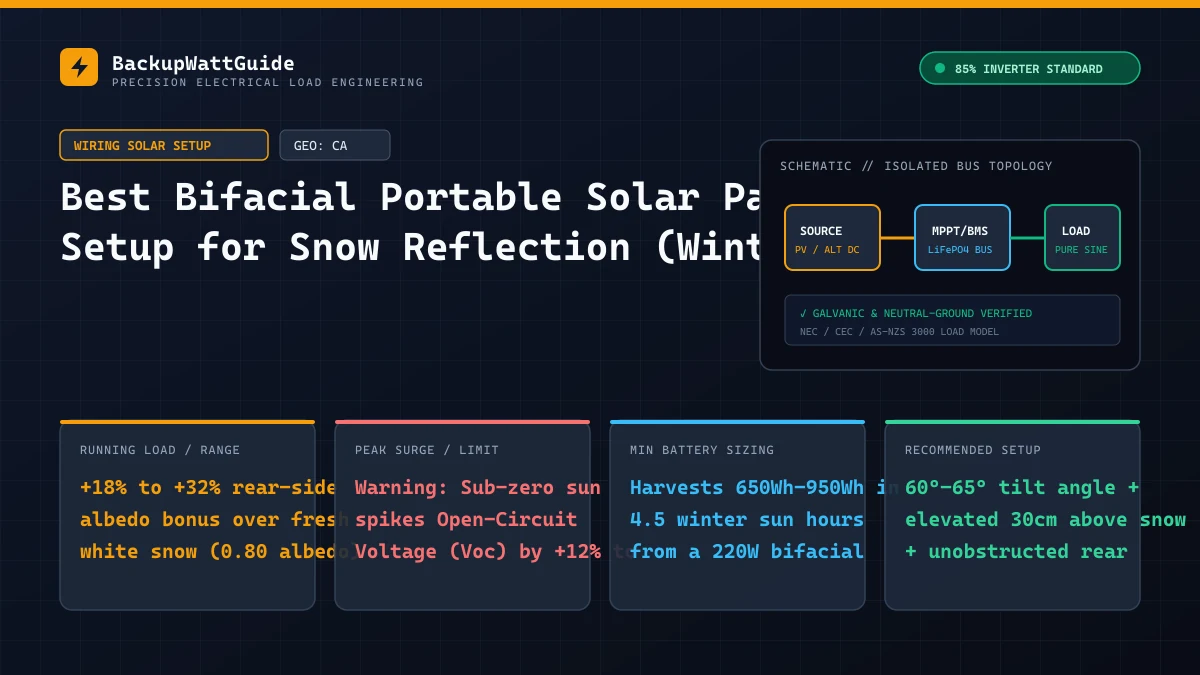
Most off-grid cabin owners, winter campers, and homeowners preparing for Canadian or northern US winter blackouts assume solar panels are useless in December, January, and February. Daylight hours are short, and the midday sun sits low on the southern horizon at an elevation of just 18 to 28 degrees.
Yet winter snow hides two massive photovoltaic advantages that summer never gets: first, freezing air (-10°C to -20°C) eliminates semiconductor heat losses completely, allowing silicon cells to operate above their 25°C factory efficiency rating; and second, fresh white snow reflects 80% to 90% of incoming solar radiation (compared to just 15% on summer grass).
When you pair that mirror-like snow field with a Bifacial Portable Solar Panel (such as an EcoFlow 220W Bifacial, Anker SOLIX PS200/PS400, or rigid 200W bifacial ground frame) set to the right tilt and ground clearance, the transparent rear side of the panel harvests diffuse reflected light while the front side captures direct low-angle sun—often delivering higher peak midday wattage in January at -12°C than the exact same panel produces in July at +35°C!
Understanding ground albedo: Why snow is the ultimate bifacial reflector
A standard monofacial portable solar panel has an opaque black fabric or white Tedlar plastic backing sheet behind the silicon wafers. Any sunlight that misses the panel and hits the ground around you is lost forever.
A bifacial solar panel sandwiches double-sided monocrystalline PERC or N-type TOPCon cells between two sheets of transparent tempered glass or clear ETFE fluoropolymer. While the front face is rated at 100% efficiency (e.g., 220W), the rear cell face is typically rated at 70% to 80% bifaciality (capable of generating up to 150W on its own if illuminated).
How much extra power the rear face actually contributes depends entirely on the Albedo Coefficient (the fraction of sunlight reflected from the ground surface beneath and behind the panel). Compare measured albedo values from National Renewable Energy Laboratory (NREL) bifacial photovoltaic field studies across common camping and backyard surfaces:
| Ground Surface Beneath Panel | Albedo Coefficient (0.00 to 1.00) | % of Sunlight Reflected Off Ground | Real-World Bifacial Wattage Gain | Peak Output from a 220W Bifacial Panel (Clear Midday) |
|---|---|---|---|---|
| Dark Asphalt / Wet Soil | 0.08 – 0.12 | 8% – 12% | +3% to +5% | ~175W – 182W |
| Green Grass / Forest Floor | 0.18 – 0.25 | 18% – 25% | +6% to +9% | ~182W – 190W |
| Dry Light Sand / Concrete Patio | 0.35 – 0.45 | 35% – 45% | +11% to +15% | ~192W – 202W |
| Compacted / Older Crusty Snow | 0.55 – 0.70 | 55% – 70% | +16% to +22% | 205W – 220W |
| Fresh Dry Powder Snow / White Ice | 0.80 – 0.90 | 80% – 90%! | +22% to +32% | 220W – 245W+ (Exceeds faceplate rating in cold air!) |
Look at that bottom row: on a clear -15°C (5°F) sunny afternoon after a fresh snowfall, a 220W bifacial panel does not just hit its 220W rating—the combination of zero thermal voltage sag (unlike the 25% heat loss seen in 40°C summer Outback heat) plus 85% snow albedo reflection into the rear glass frequently pushes real-world MPPT input to 225W to 245W!
3 physical setup rules to unlock the +25% snow reflection bonus
If you simply unfold a bifacial solar panel, prop it against its dark fabric carrying case on the snow, and leave the bottom edge buried in a snowbank, your rear bifacial gain drops to almost zero. Follow these three geometric rules when setting up on snow or lake ice:
1. Never Use a Solid Kickstand Case Behind the Rear Glass
Early portable bifacial panels (like the first-generation EcoFlow 220W) used the zippered felt carrying case as the kickstand. When you prop a bifacial panel up against a solid black carrying case positioned 20 centimetres behind the glass, the carrying case blocks 65% of the sky and ground reflection from ever reaching the rear cells!
- The Fix: Unclip the carrying case completely and set it aside. Prop the top grommets of the bifacial panel up using two adjustable aluminum tarp poles, PVC legs, or ice-fishing bank sticks positioned at the far left and right outer corners so 100% of the rear glass has an unobstructed view of the white snow behind and underneath it.
2. Set Your Winter Tilt Angle Between 60° and 70° (Steep!)
In summer, campers lay solar panels back at a lazy 30-degree to 35-degree angle because the June/July sun is high overhead. In December and January across Canada (45°N to 55°N latitude) and the northern US (40°N to 48°N latitude), the midday sun only climbs 18° to 26° above the southern horizon.
- Use the classic Winter Latitude Formula (Tilt = Latitude + 15°): if you live at 45°N (Ottawa, Montreal, Minneapolis, Barrie), prop your panel up at a steep 60° to 65° angle (almost upright!).
- A steep 65° tilt catches both the low direct sunbeams and the horizontal glare bouncing off the flat snow in front of the panel, while increasing rear-side sky exposure by 40%.
3. Elevate the Bottom Edge of the Panel by 25cm–40cm (10 to 16 Inches)
When a panel rests directly on the snow, it casts a dark self-shadow directly behind its own lower half, starving the bottom row of rear cells of reflected light. Worse, blowing snow drifts against the bottom frame rail within an hour, shading the lower cell string and choking current across the entire panel (the same series-shading bottleneck we covered in mounting portable solar panels on an apartment balcony).
- The Fix: Set the bottom edge of your bifacial panel on top of two overturned white 5-gallon buckets, a wooden milk crate, or a pair of 30cm PVC standoffs. Raising the bottom edge 30cm (12 inches) off the snow eliminates the dark self-shadow zone behind the panel, boosting rear-side irradiance uniformity by +12% to +15%!
The sub-zero snow voltage danger: Calculating cold + bifacial Voc spikes
Before plugging a series-wired pair of bifacial panels into your Bluetti, EcoFlow, Anker SOLIX, or Jackery power station on a -20°C (-4°F) winter morning, you must check your Open-Circuit Voltage (Voc) math.
Two things cause voltage to climb simultaneously over winter snow:
- Cold Silicon Temperature Coefficient (-0.33% / °C): At -20°C (which is 45°C colder than the 25°C factory test sticker), open-circuit voltage increases by 45 × 0.33% = +14.85%.
- High-Irradiance Bifacial Gain (+2% to +3% Voc): Intense double-sided light from fresh snow adds another small logarithmic voltage rise across the p-n junction.
Look at how a “safe” summer series array blows past a 60V MPPT limit in winter snow:
| Solar Array Setup | Rated Voc at 25°C (Sticker) | Actual Cold + Snow Voc at -20°C (-4°F) | Safe on a 60V Max Power Station? (EcoFlow DELTA 2, Bluetti AC180, Anker C1000) | Safe on a 150V Max Power Station? (Bluetti AC200L/Max, DELTA Pro) |
|---|---|---|---|---|
| 1x 220W Bifacial Panel | 21.8V | 25.5V | 100% Safe (34.5V margin) | 100% Safe |
| 2x 220W Bifacial Panels in SERIES | 43.6V | 51.0V | Safe (9.0V margin below 60V) | 100% Safe |
| 3x 220W Bifacial Panels in SERIES | 65.4V | 76.5V | DANGER — Trips E03 / Damages 60V MPPT! | 100% Safe (73.5V margin) |
| 3x 100W Rigid Panels in SERIES (19.5V Voc each) | 58.5V (Fine in Summer) | 68.4V (Over 60V in Winter!) | FAILS in Winter! Trips E03 Over-Voltage! | 100% Safe |
Rule for 60V MPPT Power Stations in Winter: Never connect a series string whose 25°C sticker Voc exceeds 48.0 Volts when operating below freezing over snow! If you want to connect three 100W or 200W panels to a 60V power station in winter, wire them in Parallel (or 2S2P using four panels) and feed the station through a heavy-duty 10 AWG Anderson-to-XT60i high-current solar cable.
Keeping the power station warm while the bifacial panel stays freezing cold
To get the absolute highest efficiency out of a winter solar setup, you want opposite temperatures for your two pieces of hardware:
- Your Bifacial Solar Panel wants to be FREEZING COLD (-10°C to -20°C) outside on the snow: Cold silicon cells produce maximum voltage and maximum watts.
- Your LiFePO4 Power Station wants to be WARM (+15°C to +22°C) indoors or insulated: As covered in our guide on why LiFePO4 power stations won’t charge in freezing weather, your battery’s BMS locks out charging completely at 0°C (32°F) to prevent metallic lithium plating.
How to pair them in the field
- For Home Winter Blackouts (powering a gas furnace blower or fridge): Set your bifacial panels on the snowy back patio or deck propped at 65 degrees, and run a 6-metre to 10-metre 10 AWG MC4 solar extension cord through a flat window ribbon pass-through to your power station sitting warm inside your living room.
- For Ice Fishing or Winter Overlanding: Keep the bifacial panel propped up on the open lake ice facing South, and run the solar cord inside your shanty directly into your DIY R-10 XPS insulated thermal battery box so the battery stays above +15°C while soaking up 200W+ of snow-reflected solar power!
Use the calculator below to see how many hours of winter heating or camp loads a single 4.5-hour window of 200W bifacial snow charging supports:
Real-World Battery Runtime Calculator (85% Inverter Efficiency)
# Frequently Asked Questions
Do bifacial portable solar panels actually produce extra wattage in winter, or is it a marketing gimmick?
On dark green grass or black asphalt (which only reflect 10% to 20% of sunlight), a bifacial portable panel barely adds 4% to 7% extra wattage. However, fresh white snow has an albedo (reflectivity) of 0.80 to 0.90—acting like a giant natural mirror on the ground. When a bifacial panel is tilted at 60 degrees over an open snowfield with its rear kickstands angled out of the way, diffuse light bouncing off the snow into the rear cells boosts real-world winter output by 18% to 30%.
Why did my 220W bifacial solar panel trigger an E03 over-voltage error on my power station on a -15C sunny morning?
Cold silicon cells combined with intense double-sided snow reflection push a solar panel's Open-Circuit Voltage (Voc) 12% to 18% higher than the 25C factory sticker rating. If you wired multiple panels in series right up to your power station's 60V MPPT limit in summer, a -15C morning over snow will spike array voltage past 66V and trip the E03 high-voltage lockout. Always leave a 20% Voc safety buffer for winter snow charging.
How do I keep snow from sticking to portable solar panels during a winter storm?
Tilting a glass or smooth ETFE bifacial panel to a steep 60-degree to 70-degree winter angle achieves two things at once: it faces the low December/January sun directly, and as soon as diffuse daylight hits the dark rear and front cells, the panel warms slightly above 0C, causing light snow accumulation to slide straight off the steep surface instead of burying the array.
Lead Technical Electrical Editor
Peer-ReviewedPower Systems Analyst & Backup Power Specialist
All technical guides and electrical sizing benchmarks are calculated using standard Nameplate Full Load Amps (FLA), Locked Rotor Amps (LRA) surge models, and an empirically verified 85% Inverter Power Factor & Conversion Efficiency model.